What Do Professional Concrete Slab Contractors Do?
Professional slab contractors manage every step of creating a flat, durable concrete surface. They don't just show up and pour — they assess your site, prepare the ground properly, and pour concrete using techniques that prevent the most common failure points.
Most experienced crews can complete a standard residential slab project in a single day, starting early and finishing before dinner.
Site Preparation and Grading
The first job is excavating to the right depth and grading the area so water drains away from the slab. Contractors remove topsoil and organic material that would compress over time, then establish proper slope — typically a quarter-inch drop per foot moving away from structures.
They'll compact the subgrade soil using a plate compactor or roller, checking for soft spots that signal poor drainage or fill. In Wisconsin, contractors account for frost depth requirements when planning slab placement.[3] Northern counties require consideration for frost lines reaching 48 inches, which affects how slabs near existing foundations are positioned and protected.
A qualified crew knows these local requirements without being told.
Forming and Reinforcement Installation
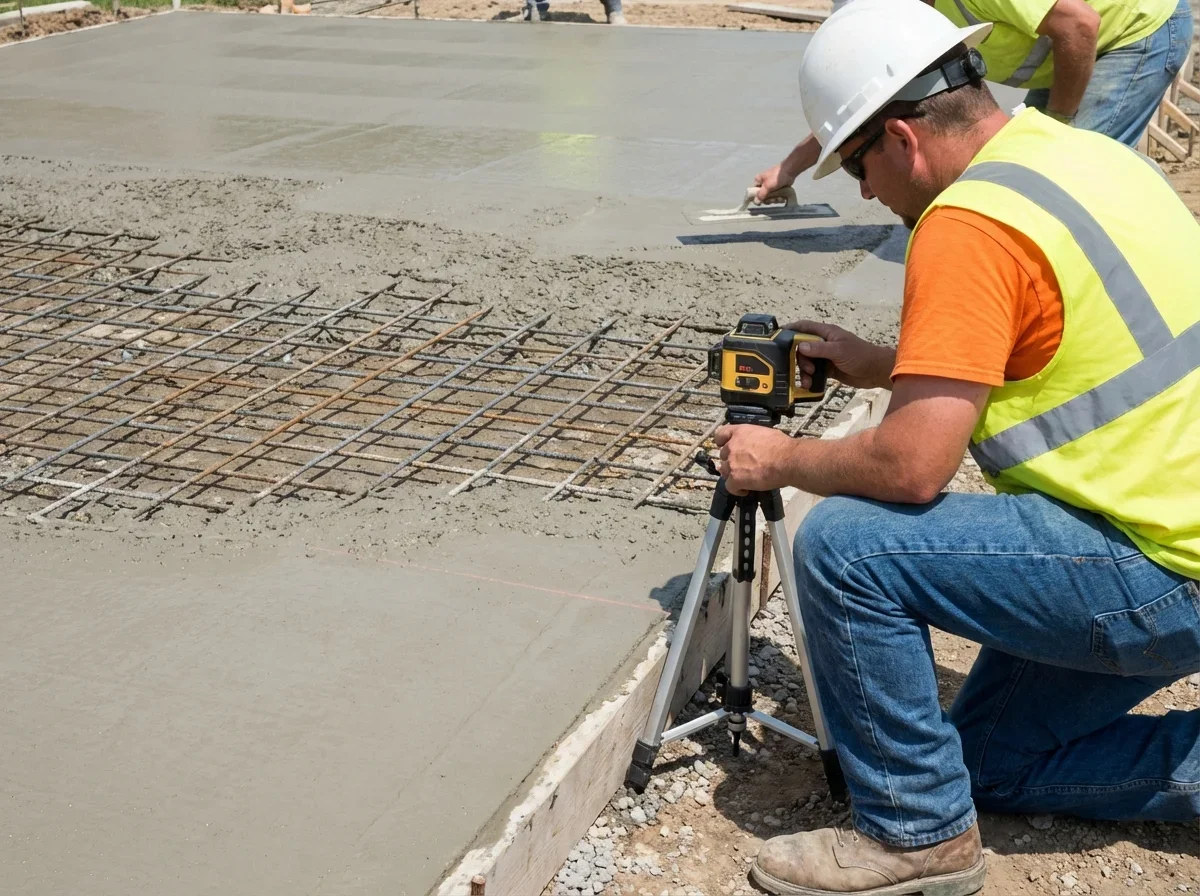
Once the base is ready, contractors build wooden or metal forms that define the slab's perimeter and hold concrete in place while it cures. They set forms level and brace them securely — a shifted form means an out-of-level slab.
Next comes the base layer and reinforcement. Professional installations include 4 to 6 inches of compacted gravel or crushed stone spread evenly across the excavated area.[2] This base provides drainage, prevents settling, and keeps moisture from wicking up through the concrete. Reinforcement goes in next: rebar grids for heavy-load applications or welded wire fabric for lighter residential slabs.
The choice depends on what you're building on top of that concrete.
Pouring and Finishing Techniques
Concrete arrives by truck, and contractors work quickly once it starts flowing. They spread and level the mix, working it into corners and around any embedded anchor bolts or utilities. Screeding comes first — dragging a straight board across the forms to establish a flat surface.
Then they float the concrete to smooth it further and bring a workable layer of cement paste to the top.
Finishing depends on the slab's purpose. Garage and workshop floors get a smooth troweled finish for easy sweeping and equipment rolling. Outdoor pads receive a broomed texture for slip resistance. Contractors also cut or form control joints — deliberate weak points that guide where cracks form as concrete shrinks during curing.
A slab without properly placed control joints will crack randomly, often in visible, jagged lines.
Common Concrete Slab Applications
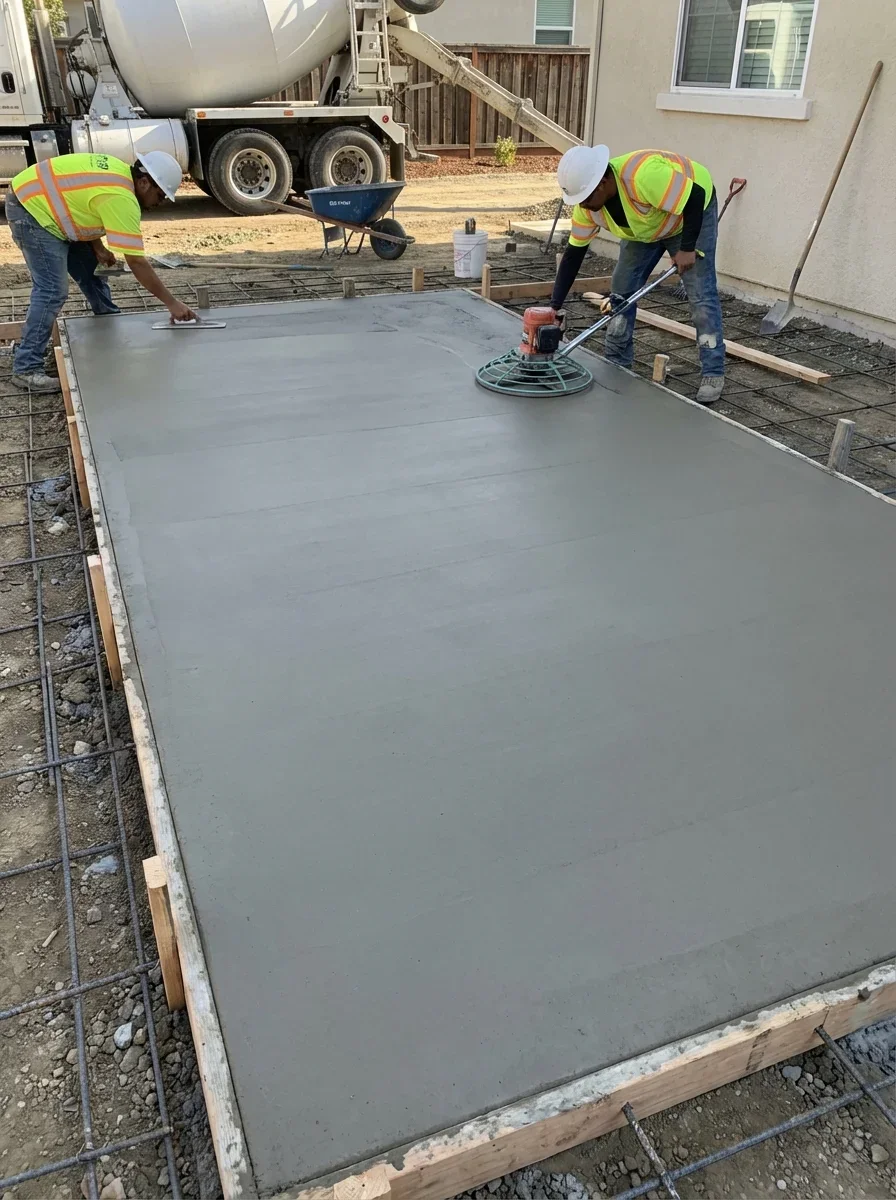
Concrete slabs serve dozens of purposes around a property, but a few applications dominate contractor schedules. Each has specific requirements for thickness, reinforcement, and finish quality.
Garage and Workshop Slabs
Garage slabs carry vehicle weight, tool storage, and sometimes heavy equipment. Contractors pour these at 5 to 6 inches thick to handle the load without cracking under point pressure from tires or jack stands.[1]
The extra thickness provides durability for decades of use — garages don't get replaced often, so the slab needs to outlast multiple vehicles.
Reinforcement typically includes a rebar grid on 18- to 24-inch centers, placed mid-depth in the slab. The concrete gets a smooth trowel finish that makes sweeping easy and prevents dust accumulation. Contractors also slope garage slabs slightly toward the door (about 1-2% grade) so spills and snowmelt drain out instead of pooling inside.
Shed and Storage Building Foundations
Smaller structures like garden sheds and storage buildings need solid foundations too, but not always 6-inch garage-grade slabs. A 4-inch residential slab works fine for most sheds, keeping the structure level and off the ground while preventing moisture rot in floor joists.[1]
Contractors often use fiber mesh reinforcement in shed slabs instead of rebar — it's faster to install and provides adequate crack resistance for lighter loads. The finish can be basic; no one's rolling a creeper across a shed floor.
What matters is that the slab sits on properly compacted base material and drains well. Shed slabs that settle even an inch create door alignment problems and stress on wall framing.
RV Pads and Equipment Storage
RV pads handle concentrated weight from stabilizer jacks and axles, often for months at a time. Contractors pour these at least 5 inches thick, sometimes 6 inches for larger motorhomes or equipment trailers.
The slab needs to be level side-to-side (RV refrigerators require level operation) but should slope front-to-back for drainage.
Many homeowners use RV pads for boat trailers, utility trailers, or seasonal equipment storage. The slab keeps everything off grass and mud, eliminates ruts, and provides a stable surface for loading and unloading. A textured finish improves traction in wet conditions, and some contractors add tie-down anchors cast into the concrete for securing loads during storms.
| Application | Thickness | Reinforcement Type | Typical Cost Range |
|---|---|---|---|
| Shed Foundation | 4 inches | Fiber mesh or wire fabric | $5-$8 per sq ft |
| Garage Slab | 5-6 inches | Rebar grid (18-24" centers) | $8-$12 per sq ft |
| RV Pad | 5-6 inches | Rebar grid with anchors | $9-$15 per sq ft |
| Walkway/Patio | 4 inches | Wire fabric or fiber mesh | $6-$10 per sq ft |
What Should a Professional Slab Installation Include?
Not all concrete work is equal. Professional contractors follow standards that prevent the most common slab failures: settling, cracking, drainage problems, and frost heave.
You're paying for these details whether you see them or not.
Proper Base and Drainage Preparation
The base determines how well a slab performs long-term. Contractors spread 4 to 6 inches of crushed stone or gravel, then compact it in lifts — layering and compacting in stages rather than dumping the full depth at once.[2]
Proper compaction prevents settling, which shows up as cracks or low spots within the first year.
Drainage preparation includes grading the subgrade to direct water away from the slab and adding perimeter drains if the site has poor natural drainage. In Wisconsin, frost protection is non-negotiable for slabs near building foundations.[3] Contractors account for frost depth in base design and slab placement, ensuring water doesn't pool under the slab where it can freeze and heave the concrete.
Homeowners rarely see this work after it's buried, but it's where many cheap jobs fail.
Reinforcement Standards by Application
Reinforcement controls where and how cracks develop. Concrete will crack — it shrinks as it cures and expands and contracts with temperature swings. Reinforcement doesn't prevent cracks; it holds the slab together at crack locations so they don't widen into structural problems.
Rebar grids work best for heavy-load slabs like garages and RV pads. Contractors tie intersecting bars into a grid pattern and support them on chairs so the steel sits mid-depth in the slab. Welded wire fabric (wire mesh) suits lighter applications like shed foundations and walkways. Fiber mesh — synthetic fibers mixed into the concrete — provides basic crack resistance for low-stress slabs.
Your contractor should match reinforcement to the application without you having to specify it.
Control Joints and Crack Prevention
Control joints are planned cracks — shallow grooves cut or formed into the concrete that create weak points where stress cracks appear. Contractors space control joints no more than 10 feet apart in any direction, creating a grid pattern that segments the slab into smaller panels.
Joints can be tooled (formed during finishing), saw-cut (cut into fresh concrete within hours of pouring), or formed with plastic strips embedded before the pour. Saw-cut joints are most common on larger slabs; contractors return the same day or next morning to cut joints before random cracks develop.
Slabs without control joints crack randomly in the first year, often running diagonally across the surface in ugly, irregular lines. Properly placed joints guide cracks into straight, predictable locations that are far less noticeable.
Pro Tip: Control joints should be spaced at intervals no greater than 2-3 times the slab thickness in feet. For a 4-inch slab, that means joints every 8-12 feet maximum. Contractors who skip this step leave you with unpredictable cracking patterns that are impossible to fix without replacing the entire slab.
How Much Do Concrete Slabs Cost?
Concrete slab pricing depends on size, thickness, site conditions, and finish requirements. Contractors typically quote by the square foot, with costs ranging from $5 to $10 per square foot for basic residential slabs and $8 to $15 per square foot for thicker garage or commercial-grade work.
A 10×12 shed slab (120 square feet at 4 inches thick) might run $600 to $1,200 depending on site access and base prep needs. A 20×24 garage slab (480 square feet at 6 inches thick) typically costs $3,800 to $7,200.
Prices climb when contractors encounter poor soil requiring extra base depth, difficult access that limits concrete truck placement, or extensive grading work.
Homeowners sometimes express sticker shock at slab quotes, especially when comparing multiple bids that vary widely. Getting three quotes is standard practice — it helps you understand what's included and what's extra. Lower bids sometimes skip proper base depth or use minimal reinforcement. Higher bids may include details like vapor barriers, upgraded finishes, or thicker concrete that cheaper contractors omit.
Ask what's included rather than assuming all quotes cover the same scope.
Minor fixes or adjustments after the pour — like stabilizing a wobbly step or cleaning up leftover debris — occasionally require follow-up visits. Reputable contractors return promptly to address these issues when they arise. Some also offer warranties on their work, particularly for specialized services like polyurethane foam lifting for settled slabs (typically covered for five years).
How to Choose a Qualified Slab Contractor
Start with verification: licensed, insured, and experienced with your specific application. Wisconsin requires contractors to carry liability insurance, and you should confirm coverage before signing anything. Licensing requirements vary by municipality, but established contractors readily provide proof of credentials.
Ask about their process for site prep, base depth, and reinforcement. A qualified contractor explains these steps clearly without getting defensive. Red flags include vague answers about base material ("we'll put some gravel down") or dismissing reinforcement as unnecessary ("concrete's strong enough on its own").
Request references for similar projects — a contractor who's poured 50 garage slabs can answer questions a generalist can't.
Communication matters more than many homeowners expect. Responsive contractors who explain the process and stick to quoted prices save headaches later. Family-owned or locally established firms often provide this level of service consistently; they depend on reputation in a small market. Ask how they handle curing (keeping concrete moist for several days prevents surface cracking) and what you should expect for timeline.
Most residential slabs are walkable in 24 to 48 hours but shouldn't carry heavy loads for at least seven days.
Key Questions to Ask Before Hiring:
- What's included in the base preparation? (depth, material type, compaction method)
- What reinforcement will be used for my specific application?
- How are control joints planned and executed?
- What's the curing process and timeline before full use?
- Is cleanup and site restoration included in the quoted price?
- What warranty or guarantee do you offer on the work?
- Can you provide three local references from the past year?
Inquire about cleanup and site restoration. Concrete work generates waste — form lumber, excess stone, muddy runoff. Some contractors leave sites cleaner than they found them; others leave debris piles for you to handle.
This difference shows up in reviews and references, not written quotes. A crew that finishes on time, cleans thoroughly, and communicates well through the process makes the entire experience less stressful.
Find Concrete Slab Contractors in Your Area
Professional slab installation transforms properties — you get a level, durable surface that handles vehicles, structures, or equipment for decades. The best contractors combine technical skill with clear communication, finishing projects efficiently while building slabs that resist Wisconsin's freeze-thaw cycles and heavy loads.
Start by identifying contractors with strong local track records, verified licensing, and experience with your specific slab application. Compare quotes carefully, ask about their base preparation and reinforcement methods, and check references before committing.
The right contractor makes a complex job look simple, delivering a finished slab that performs exactly as intended from day one.
Frequently Asked Questions
- Iowa State University Extension and Outreach. "Concrete Floors on Grade." https://www.extension.iastate.edu/documents/ans1052.pdf. Accessed February 09, 2026.
- American Concrete Institute (ACI). "Building Code Requirements for Structural Concrete." https://www.concrete.org/standards/specifications-and-codes. Accessed February 09, 2026.
- Wisconsin Department of Safety and Professional Services. "Foundation Design Guide for Wisconsin." https://dsps.wi.gov/Documents/Industry/Building/Codes/Energy/2023-WisconsinEnergy-Code.pdf. Accessed February 09, 2026.