What Do Professional Sidewalk Contractors Do?
Flatwork concrete contractors handle the entire lifecycle of sidewalk projects, from permit applications and base excavation through finishing and joint cutting. They prep subgrades to proper compaction levels, install forms that maintain grade requirements, and pour concrete with the right mix design for your climate.
Most importantly, they know where and how to place control joints so cracks happen where you want them — in straight lines at predetermined intervals — rather than randomly across your walkway.
Many contractors also handle repair work: leveling settled sections through mudjacking or foam injection, replacing individual damaged panels, and grinding down trip hazards to code-compliant thresholds. If you're dealing with a public sidewalk, they navigate the permit process and ensure the finished product meets ADA slope and width requirements.[1]
The best flatwork specialists understand that sidewalks fail from the bottom up.
Poor drainage, inadequate base compaction, or skipped expansion joints cause problems that show up months or years later — long after a general concrete contractor has moved on.
Key Services Professional Sidewalk Contractors Provide:
- Complete installation from excavation to finishing
- Permit applications and ADA compliance verification
- Proper control joint placement to prevent random cracking
- Mudjacking and foam injection for settling repairs
- Panel replacement for damaged sections
- Trip hazard grinding to code-compliant thresholds
How Quality Sidewalk Installation Works
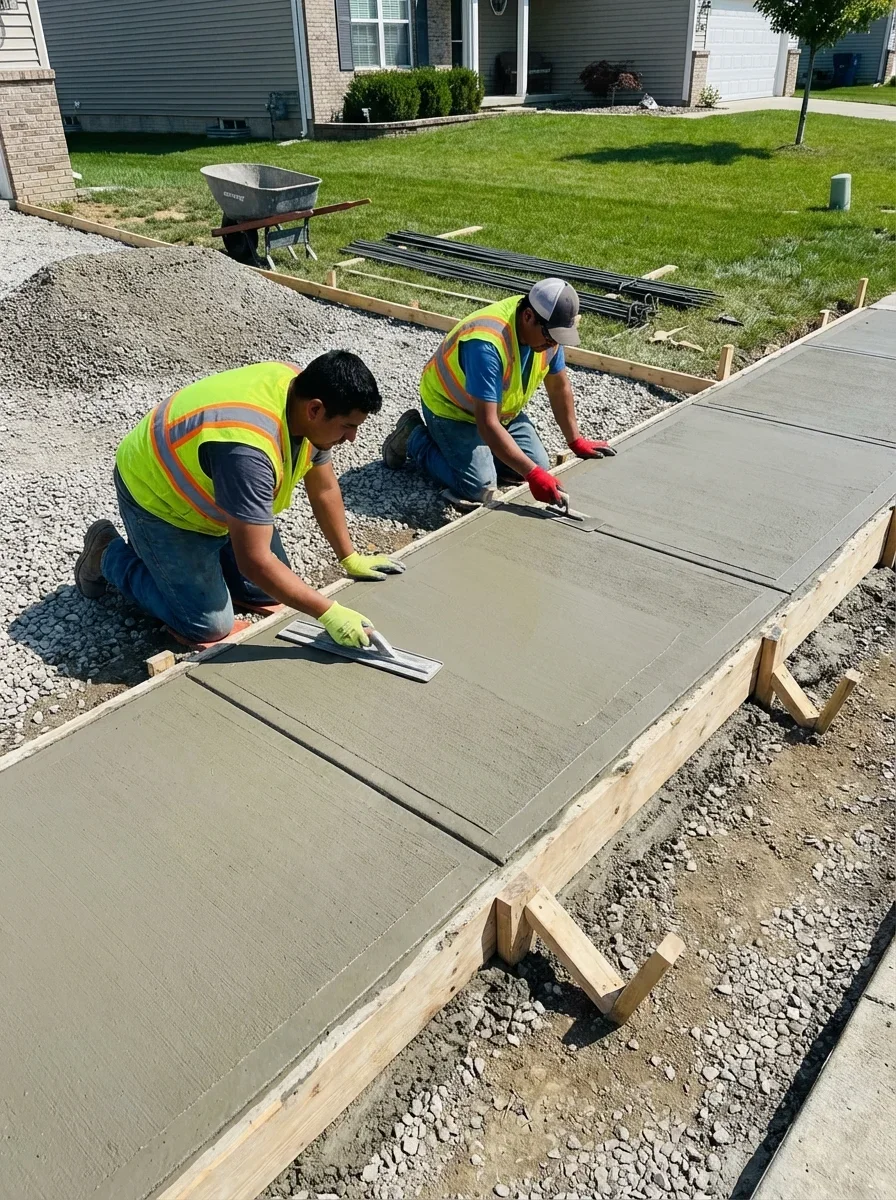
A properly installed sidewalk starts well before the concrete truck arrives. The installation process follows a sequence that addresses drainage, structural support, and long-term crack control.
Cut corners on any step, and you'll see the consequences within a few freeze-thaw cycles.
Base Preparation and Grading
Contractors excavate to the required depth and install 4-6 inches of compacted granular base material — typically crushed stone or gravel compacted to 95% density.[3] This provides stable support and prevents settling that creates trip hazards later. The base also allows water to drain away rather than pooling under the slab.
Proper grading matters as much as compaction.
Sidewalks need a cross-slope (side to side) of about 1/4 inch per foot to shed water, and a running slope (lengthwise) that stays below 5% to meet ADA requirements for public walkways.[1] Even residential sidewalks benefit from these standards — standing water accelerates deterioration in any climate.
Concrete Thickness and Reinforcement
Most residential sidewalks use a 4-inch slab thickness as the minimum standard.[2] Contractors pour thicker slabs (5-6 inches) if the sidewalk crosses tree root zones, unstable soil, or areas with heavy equipment access.
The concrete mix itself should be designed for your climate — air-entrained mixes with 5-7% air content resist freeze-thaw damage in cold regions.
Reinforcement depends on the application. Wire mesh or fiber reinforcement helps control minor cracking but doesn't prevent it — that's what joints are for. Some contractors skip reinforcement entirely in standard residential sidewalks, relying instead on proper joint spacing and a well-compacted base.
Joint Placement and Finishing
Control joints are saw-cut or tooled grooves that create weak points where concrete can crack in a controlled, straight line rather than randomly. Spacing should be 2-3 times the slab width — for a 30-inch wide sidewalk, that means joints every 5 feet at most.[2]
Joints are cut to roughly 1/4 of the slab depth, usually within 12 hours of pouring.
Expansion joints separate the sidewalk from fixed structures like building foundations, stairs, or driveways. These joints allow for thermal expansion and contraction without transferring stress. Contractors use compressible filler material that compresses under pressure and rebounds when temperatures drop.
Finishing involves troweling the surface smooth, then applying a broom finish for traction. Some homeowners opt for decorative finishes like stamping or exposed aggregate, but a simple broom finish performs better in freeze-thaw climates and costs significantly less.
Sidewalk Repair Options Contractors Offer
Sidewalks fail in predictable ways: settlement from soil erosion, cracking from missing or improperly spaced joints, and surface spalling from freeze-thaw cycles.
The repair approach depends on what's actually wrong — and whether the base beneath the concrete is still stable.
| Repair Method | Best For | Cost Per Sq Ft | Lifespan |
|---|---|---|---|
| Mudjacking | Settled but sound panels | $3-6 | 5-10 years |
| Foam Injection | Lightweight lifting, unstable soil | $5-10 | 8-15 years |
| Panel Replacement | Cracked/spalled concrete | $8-15 | 20-30 years |
| Grinding | Minor trip hazards (under 1/2") | $2-4 | 3-5 years |
Leveling Settled Sections
When soil erodes or compresses beneath a sidewalk panel, the slab settles and creates a trip hazard. If the concrete itself is still sound, mudjacking (also called slabjacking) pumps a cement-based slurry beneath the panel to lift it back to grade. The process is messy but effective for short-term leveling.
Polyurethane foam injection works similarly but uses expanding foam instead of slurry.
It's cleaner, lighter, and less likely to overload already compromised soil, but costs more per panel. Both methods work only if the soil has stabilized — if erosion continues, the panel will settle again.
Many municipalities define trip hazards as vertical displacement of 1/2 inch or more. Property owners are often liable for injuries, so leveling settled sections isn't just cosmetic.
Replacing Damaged Panels
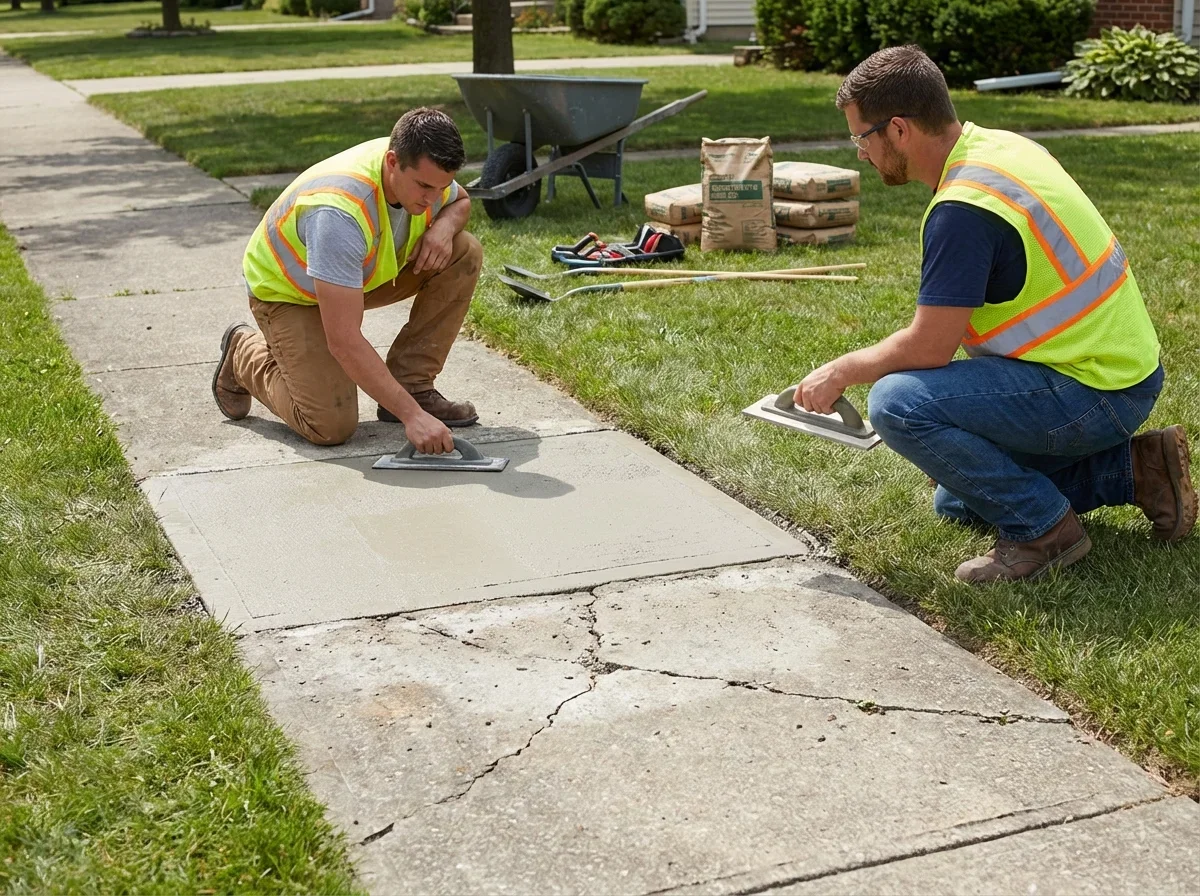
When concrete has cracked through, spalled badly, or shifted beyond repair, replacement makes more sense than patching. Contractors cut out the damaged section, re-excavate and compact the base if needed, and pour a new panel that matches the thickness and finish of the surrounding sidewalk.
Matching existing concrete is harder than it sounds.
Color varies by mix design and weathering, so new panels often look noticeably different for a year or two until they weather in. Contractors can add pigments to approximate the color, but perfect matches are rare.
Partial replacement costs more per square foot than new installation because of the cutting, removal, and precision work involved. But it's still cheaper than tearing out an entire sidewalk when only a few sections have failed.
What Should Sidewalk Work Cost?
New sidewalk installation typically runs $6-12 per square foot for basic residential work — straight runs, standard broom finish, no significant grading challenges. That price includes excavation, base prep, forming, pouring, and finishing.
Projects with curves, slopes that require retaining walls, or decorative finishes like stamping can push costs to $15-20 per square foot.
Sidewalk repair costs vary by method. Mudjacking settled panels generally costs $3-6 per square foot, while polyurethane foam injection runs $5-10 per square foot. Full panel replacement averages $8-15 per square foot depending on access, removal complexity, and whether the base needs rebuilding.
Municipality-required public sidewalk work often costs more because contractors must navigate permitting, inspections, ADA compliance, and sometimes utility coordination. Some cities share costs with property owners; others make the homeowner cover everything.
Check your local code before accepting bids — you may be required to use licensed contractors and pull permits even for repair work on the public right-of-way.
Choosing a Flatwork Concrete Contractor
Flatwork specialization matters more than general concrete experience. A contractor who pours foundation walls all day follows different processes than someone who finishes driveways and walkways.
Look for contractors who can explain their joint spacing approach, base compaction standards, and how they handle drainage — these details separate quality work from jobs that fail prematurely.
Ask about their process for municipal permits if your project involves public sidewalks. Contractors familiar with local code know the approval timeline, required inspections, and ADA standards that apply to your street. They should also carry general liability insurance and workers' compensation coverage — sidewalk work involves heavy equipment and significant injury risk.
References matter, but focus on projects similar to yours.
A contractor who's excellent at decorative stamped patios may not have the grading expertise for a long sloped sidewalk, and someone who handles commercial parking lot flatwork may charge residential rates that don't make sense for a 40-foot walkway.
Get the scope in writing. Contracts should specify base depth and material, concrete thickness, joint spacing, finish type, and cleanup responsibilities. Vague proposals lead to disputes when the finished product doesn't match your expectations.
Pro Tip: Ask potential contractors to walk your project site and explain their specific approach to drainage and base preparation. Quality contractors will point out existing grade issues and explain how they'll address them — vague answers about "standard procedures" are a red flag that they may not understand flatwork fundamentals.
Find Sidewalk Contractors Near You
Use the directory to compare flatwork concrete contractors in your area who specialize in sidewalk installation and repair. Filter by services offered, read verified reviews from homeowners who've completed similar projects, and request quotes to compare approaches and pricing.
Whether you're replacing a few settled panels or installing a full walkway, the right contractor makes the difference between work that lasts and work that needs redoing in five years.
Frequently Asked Questions
- U.S. Access Board. "Proposed Accessibility Guidelines for Pedestrian Facilities in the Public Right-of-Way." https://www.access-board.gov/guidelines-and-standards/streets-sidewalks/public-rights-of-way/proposed-rights-of-way-guidelines. Accessed February 09, 2026.
- Portland Cement Association. "Guide to Concrete Flatwork: Concrete Sidewalks." https://www.cement.org/docs/default-source/default-document-library/concrete-sidewalks.pdf. Accessed February 09, 2026.
- Federal Highway Administration (FHWA), U.S. Department of Transportation. "Concrete Pavement Design, Construction, and Performance." https://www.fhwa.dot.gov/pavement/concrete/pubs/hif13028.pdf. Accessed February 09, 2026.