What Does Professional Concrete Patio Installation Involve?
Professional installation follows a specific sequence, and skipping steps or rushing through them creates problems you'll notice within a year or two. The work breaks into three phases: assessing your property and preparing the site, building a stable base, and placing and finishing the concrete.
Site Assessment and Preparation
Before any digging starts, experienced contractors evaluate your yard's drainage, soil conditions, and grade. They're looking for how water moves across your property, where it pools after rain, and whether your soil is predominantly clay (common in Fox Valley) or has better natural drainage.
This assessment determines where the patio should slope (typically 1/4 inch per foot away from your home), how much excavation is needed, and whether additional drainage features are necessary.
Site prep means removing sod, topsoil, and organic material down to stable subsoil. The excavation depth depends on your base requirements and concrete thickness, but you're typically looking at 8-10 inches of total removal.
Contractors who rush this step or don't excavate deep enough end up building on unstable ground that shifts over time.
Some properties need more extensive prep work. If your yard has poor drainage or a high water table, a quality contractor will address it now — not after the patio cracks. That might mean French drains, adjusting grades beyond the patio footprint, or working around tree roots that could cause future movement.
Base Work and Grading Requirements
The base layer is what keeps your patio from settling, cracking, or developing low spots.
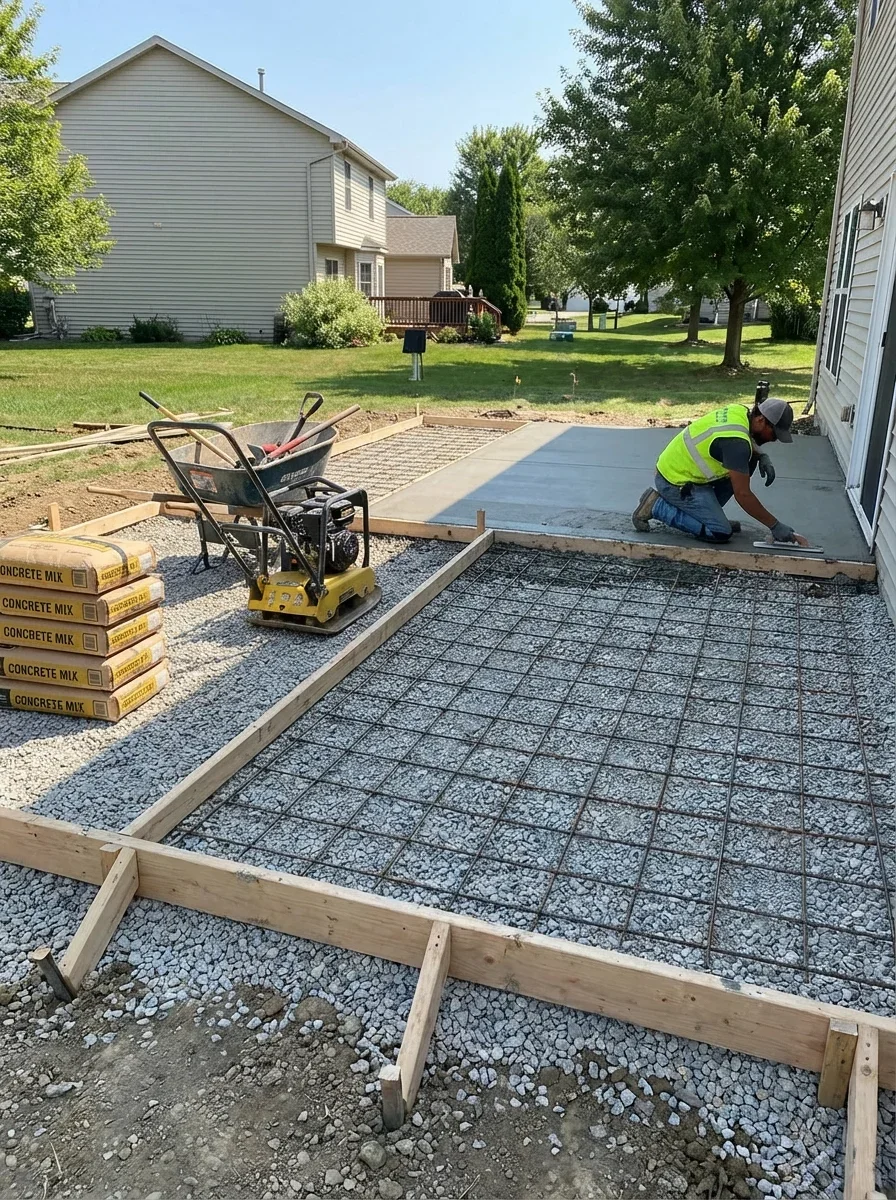
Professional work requires 4-6 inches of compacted granular material like crushed stone or gravel[1]. This layer provides uniform support and drainage — crucial in freeze-thaw climates where water trapped under concrete can heave and crack the slab.
Contractors should compact this base in layers (lifts), not all at once. Proper compaction typically means 2-3 inch layers, each compacted with a plate compactor before adding the next. You'll hear the equipment running for a while — that's normal.
What's not normal is a contractor spreading 6 inches of gravel and making one pass with the compactor.
Fox Valley's clay-heavy soils require extra attention. Clay holds water and expands when it freezes, so quality contractors ensure the gravel base extends beyond the patio edges and drains properly. Some also install a layer of landscape fabric between the clay and gravel to prevent mixing, though opinions vary on whether this helps or creates additional problems.
Concrete Placement and Finishing
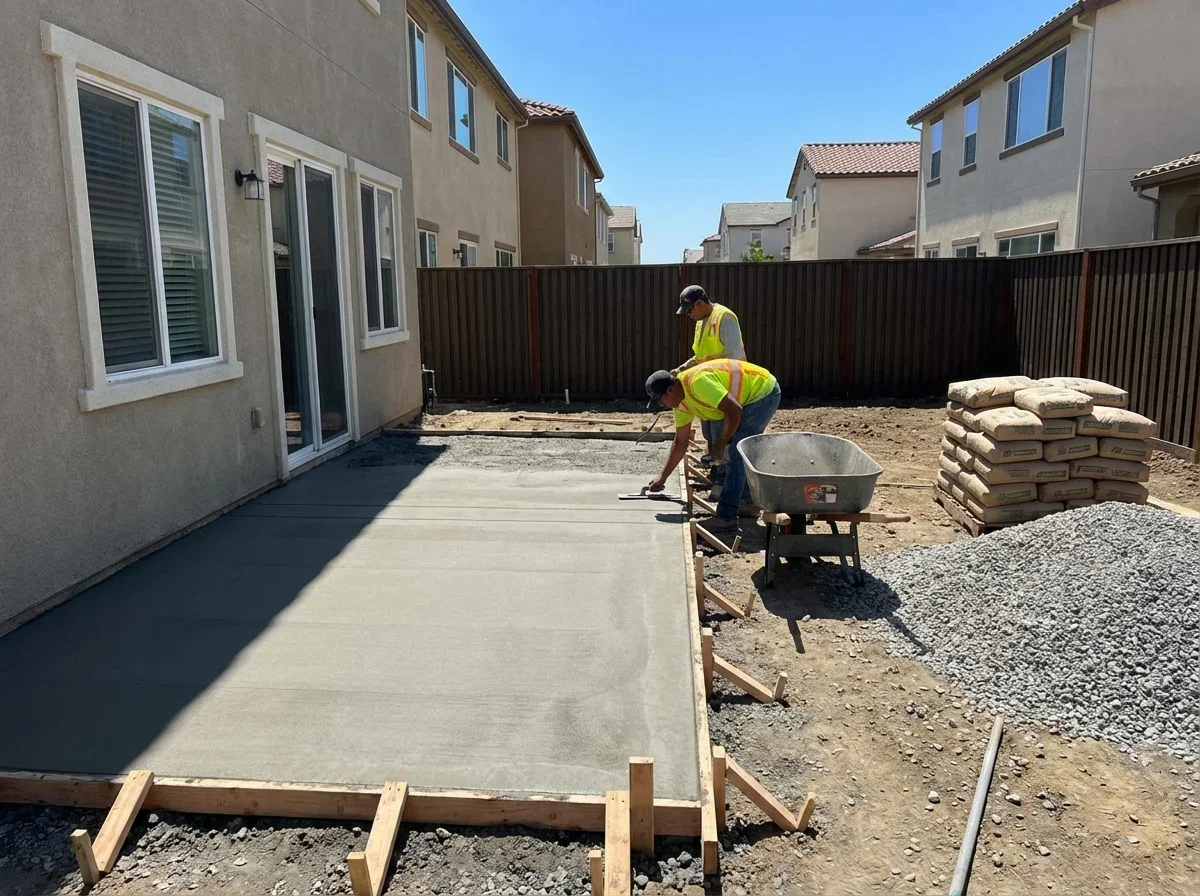
Once the base is ready, forms go up to define the patio shape and edges. Forms should be level and properly staked — they're your quality control for the final elevation and slope.
In freeze-thaw climates like Wisconsin, concrete patios need to be at least 4 inches thick with reinforcement such as wire mesh or rebar, and control joints spaced every 8-12 feet to manage cracking[2].
The concrete pour itself often happens quickly — many homeowners are surprised that the actual placement takes just a few hours for an average-sized patio. What takes time is the finishing work. Contractors have a limited window while the concrete is workable, so they work methodically: screeding to level, floating to bring cream to the surface, and applying the final finish before the concrete sets.
Proper curing is the step that gets skipped most often, especially by contractors juggling multiple jobs.
Concrete needs 7-14 days to cure properly, during which it should stay moist and protected from extreme temperatures. Some contractors apply curing compound; others cover the slab with plastic sheeting or wet burlap. Either way, rushing this process compromises strength and durability.
Professional Concrete Patio Installation Timeline:
- Day 1-2: Site assessment, marking utilities, excavation (8-10" depth)
- Day 3-4: Base installation (4-6" compacted gravel in layers), form setup
- Day 5: Concrete placement and finishing (typically 4-6 hours)
- Days 6-20: Curing period (7-14 days minimum before use)
- Total project time: 2-3 weeks from start to patio use
Concrete Patio Design Options to Discuss with Your Contractor
Basic gray concrete works, but most contractors offer finishing options that affect both appearance and function. The choices you make here impact your final cost and how the patio performs in daily use.
Broom finish is the most common for outdoor slabs. After floating, the contractor drags a broom across the surface to create texture, which provides slip resistance when wet[3]. It's practical, low-cost, and hides minor imperfections better than smooth finishes.
Trowel finish (smooth) looks cleaner but can be slippery and shows every flaw.
Exposed aggregate reveals the stone within the concrete mix, creating a decorative, textured surface. The contractor places the concrete normally, then uses chemical retarders and washing techniques to expose the aggregate before it fully sets. This finish costs more ($2-4 per square foot additional) but adds visual interest and excellent traction.
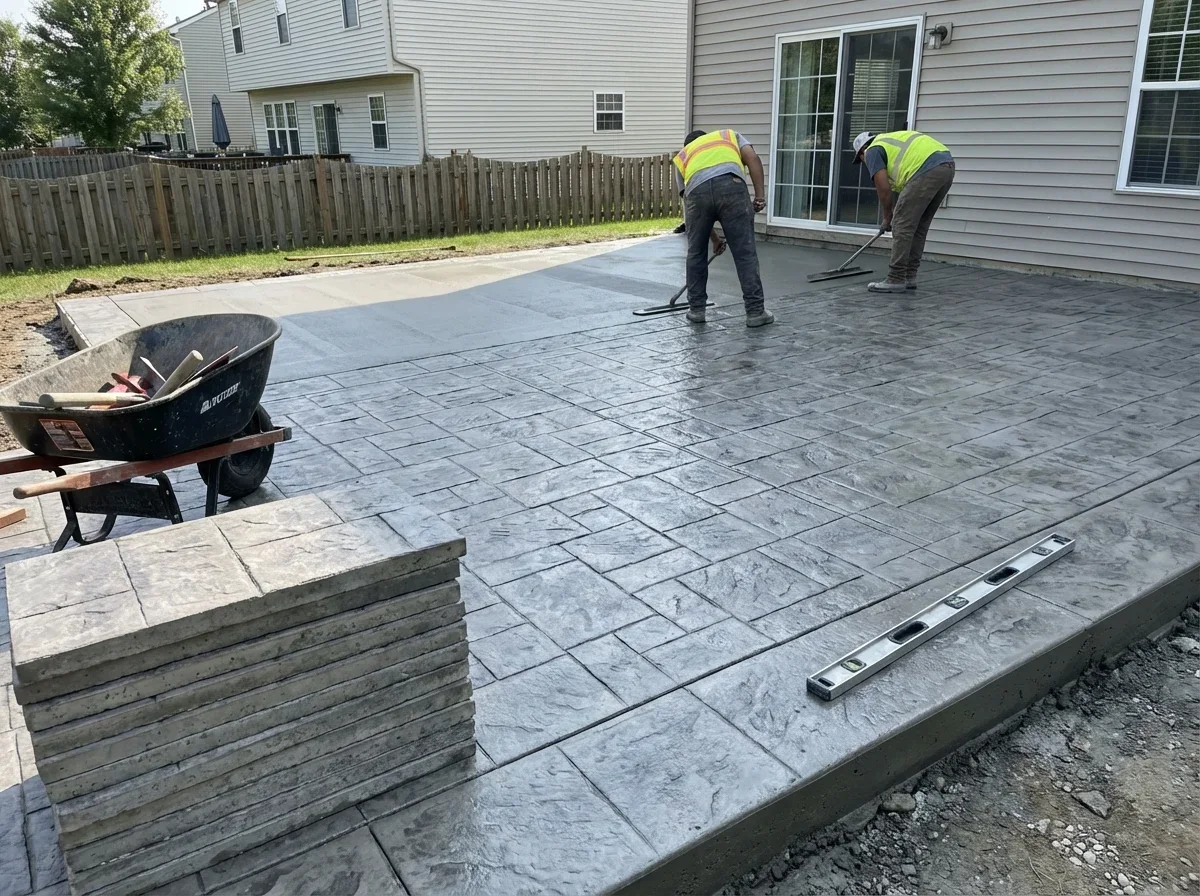
Stamped and colored concrete mimics stone, brick, or tile patterns. Contractors press texture mats into the wet concrete and often add color through integral pigments or surface stains. It's the most expensive standard finish ($12-18 per square foot), and quality varies significantly with contractor skill.
Poorly executed stamping looks artificial and can crack along pattern lines.
Shape and size flexibility is one of concrete's advantages. Curved edges, rounded corners, and custom dimensions cost little extra compared to pavers or natural stone. Contractors can also integrate step-downs, sitting walls, or planters into the design if you're working with sloped terrain or want built-in features.
| Finish Type | Cost per Sq Ft | Durability | Slip Resistance | Maintenance | Best For |
|---|---|---|---|---|---|
| Broom Finish | $8-12 | Excellent | High | Low | Budget-conscious, high-traffic areas |
| Exposed Aggregate | $12-16 | Excellent | Very High | Low-Medium | Decorative patios, pool surrounds |
| Stamped/Colored | $12-18 | Good | Medium-High | Medium-High | Premium aesthetic, entertainment spaces |
| Smooth Trowel | $8-10 | Good | Low | Low | Covered patios, modern minimalist designs |
How Much Does a Concrete Patio Cost?
Concrete patio pricing depends on size, finish complexity, site conditions, and regional labor rates. Fox Valley homeowners typically see $8-15 per square foot for standard installations, with decorative finishes pushing costs higher.
Cost Breakdown by Size and Finish Type
A basic 12x12 patio (144 square feet) with broom finish runs $1,150-2,160 for materials and labor. That assumes straightforward site conditions: level ground, good drainage, accessible location.
The same patio with exposed aggregate or a simple stamp pattern would cost $1,700-2,900.
Larger patios benefit from economies of scale — the per-square-foot cost often drops for projects over 300 square feet because setup and mobilization time stays constant. A 20x20 patio (400 square feet) might run $3,200-6,000 for standard work, or $4,800-7,200 with decorative finishes.
Most contractors quote by the square foot but itemize additional costs: thicker concrete for heavy furniture or hot tubs, extra reinforcement, decorative borders, or integrated features like fire pit pads. Get the full scope in writing before work starts.
Some homeowners report quotes that felt high, while others found pricing reasonable for the quality delivered — the range reflects both market variation and the level of prep work your specific site requires.
What Affects Installation Costs in Fox Valley?
Site accessibility plays a bigger role than many homeowners expect. If the concrete truck can't reach your backyard, the contractor pumps concrete or uses wheelbarrows — both add labor time and cost.
Tight access between houses, gates too narrow for equipment, or landscaping that complicates material delivery all increase your final bill.
Soil conditions and drainage problems drive costs up. If your property needs extensive grading, French drains, or additional base depth due to clay soil expansion issues, that's extra work the contractor can't skip without risking the patio's longevity. Properties with existing drainage issues or poor compaction from previous projects often need more prep than homes with stable, well-draining soil.
Removal and disposal of existing materials adds cost. Tearing out an old patio, breaking up concrete, and hauling debris requires time and dump fees. Some contractors include this in their base quote; others charge separately.
Clarify what "site prep" includes before signing.
Timing matters less for concrete work than other projects — contractors pour year-round when temperatures permit. But scheduling during peak season (late spring through early fall) sometimes means higher prices and longer waits for availability.
What Separates Quality Patio Contractors from the Rest
The gap between adequate and excellent concrete work often isn't visible until months or years later.
Quality contractors share specific characteristics that predict better outcomes.
Experience with local soil and climate conditions makes a measurable difference. Contractors who've worked in Fox Valley for 20+ years understand how clay soils behave, where drainage problems typically develop, and what base prep holds up through Wisconsin winters. They've seen their work age and know which shortcuts cause problems.
Thorough site assessment before quoting signals a contractor who takes the work seriously. If someone gives you a price over the phone without visiting your property, they're guessing.
Quality contractors visit the site, ask about your drainage, check soil conditions, and discuss how you'll use the space before providing a detailed quote.
Detailed quotes that break out costs for base prep, concrete thickness, reinforcement, finishing, and any extras give you transparency. Vague quotes with a single lump sum make it hard to understand what you're paying for and easier for contractors to cut corners without you noticing.
Proper equipment and crew size matter for quality outcomes. Concrete work requires coordination — one person can't place, screed, float, and finish a large patio properly before the concrete starts setting. Experienced contractors bring adequate crew and professional equipment, not just a trowel and a rented mixer.
Responsiveness during the quoting phase often predicts communication throughout the project. Contractors who return calls promptly, answer questions thoroughly, and show up on time for the estimate tend to maintain that professionalism through completion.
Those who are hard to reach early usually stay that way.
Warning: The most expensive concrete patio mistake is hiring based on price alone. A quote that's 30-40% below others typically means reduced base depth, thinner concrete, minimal reinforcement, or rushed curing — all problems that surface within 1-3 years as cracks, settling, and drainage issues. The cost to remove and replace a failed patio exceeds the original savings by 2-3x.
How to Choose a Concrete Patio Contractor
Start by identifying contractors with substantial local experience — look for those who've worked in Fox Valley for at least a decade and can provide references for similar projects. Ask specifically about their experience with area soil conditions and freeze-thaw challenges.
Verify licensing and insurance before serious conversations. Wisconsin doesn't require a state license for concrete contractors, but they should carry general liability insurance and workers' compensation coverage. Ask for proof and verify the policies are current.
This protects you if someone gets injured on your property or if the work damages your home.
Get at least three detailed quotes. Don't automatically choose the lowest — significant price gaps often reflect different scopes of work, not just better deals. A quote that's 30% below others probably assumes less base prep, thinner concrete, or minimal site work.
Ask these specific questions during contractor interviews:
- How deep will you excavate and what base material will you use?
- What thickness concrete and reinforcement do you recommend for my patio?
- How do you handle drainage given my property's slope and soil?
- What's included in site prep and what costs extra?
- How long will the project take and what's your curing process?
- Do you guarantee your work, and what does that warranty cover?
Check references, but focus on recent projects. Ask previous customers about whether the contractor stuck to the timeline, cleaned up thoroughly, and addressed any issues after completion.
Some homeowners report debris left behind or minor problems like wobbly steps that required follow-up — find out how responsive the contractor was when problems emerged.
Review the contract carefully before signing. It should specify concrete thickness, base depth and material, finish type, reinforcement details, project timeline, payment schedule, and warranty terms. Any verbal promises should appear in writing.
Expect the work to happen quickly — many patios are completed in a single day once materials arrive. What takes time is scheduling, prep work, and the curing period afterward. Clarify the full timeline from contract signing to when you can use the patio.
Find Qualified Concrete Patio Contractors Near You
The contractors listed in this directory serve Fox Valley and understand local soil conditions, climate requirements, and permitting processes. Many are family-owned businesses with decades of experience and the kind of local reputation that matters when you need someone to stand behind their work years later.
Filter contractors by your city, read reviews from other homeowners, and reach out to several for quotes.
The best fit isn't always the contractor with the most jobs or the lowest price — it's the one who understands your specific property challenges, communicates clearly, and demonstrates expertise in the questions they ask and the solutions they propose.
Quality concrete work requires both technical skill and attention to the details that don't show in the finished product. Choose a contractor who respects that reality, and you'll end up with a patio that still looks good and drains properly a decade from now.
Frequently Asked Questions
- Federal Highway Administration (FHWA), U.S. Department of Transportation. "Concrete Pavements for Airports, Streets, Roads, and Parking Areas." https://www.fhwa.dot.gov/pavement/concrete/pubs/05040/05b.cfm. Accessed February 09, 2026.
- University of Minnesota Extension. "Concrete Slab Construction." https://extension.umn.edu/concrete/concrete-slab-construction. Accessed February 09, 2026.
- American Concrete Institute (ACI). "Guide to Residential Concrete and Masonry." https://www.concrete.org/store/productdetail.aspx?ItemID=STS10719R. Accessed February 09, 2026.