Understanding Different Types of Concrete Contractors
Concrete contractors specialize in pouring, forming, placing, and finishing concrete for structures including foundations, slabs, driveways, patios, and retaining walls.[1] Their focused expertise in concrete work distinguishes them from general contractors who coordinate multiple trades but may subcontract the actual concrete placement.
The type of contractor you need depends entirely on your project scope and complexity.
Some contractors handle residential flatwork exclusively, while others focus on structural applications or decorative finishes that require specialized training and equipment.
Residential Concrete Specialists
Residential concrete contractors focus on homeowner projects: driveways, sidewalks, garage floors, basement slabs, and backyard patios. These professionals understand local building codes for residential work and typically work on smaller-scale projects than commercial contractors.
Many residential specialists offer both new installation and repair services.
You'll find contractors who excel at basic broom-finish driveways alongside those who create custom outdoor living spaces with integrated planters, steps, and drainage solutions.
Decorative and Stamped Concrete Experts
Decorative concrete contractors transform standard gray slabs into design features using stamping, staining, polishing, or overlay techniques. Creating realistic stone or brick patterns requires specialized tools, training, and an artistic eye — this isn't basic flatwork.
These specialists often carry certifications demonstrating advanced finishing skills.
ACI-certified Flatwork Finishers, for example, prove proficiency in forming, placing, finishing, and curing concrete flatwork such as driveways, patios, and sidewalks.[3] Expect to pay premium rates for decorative work, but the finished product adds substantial aesthetic value to your property.
Structural and Foundation Contractors
Foundation and structural concrete contractors handle the critical systems supporting your home. They pour footings, foundation walls, basement floors, and structural slabs that carry building loads.
This work demands precision.
Foundation tolerances measured in fractions of an inch affect everything built on top. Some structural specialists also focus on concrete lifting and leveling, using techniques like polyurethane foam injection to raise settled slabs without full replacement. Top-ranked contractors in this category often carry warranties of five years or more and consistently earn perfect ratings for quality and professionalism.[4]
| Contractor Type | Best For | Typical Projects | Skill Level Required |
|---|---|---|---|
| Residential Specialists | Homeowner flatwork | Driveways, patios, sidewalks, garage floors | Basic to intermediate |
| Decorative Experts | Custom finishes | Stamped patterns, stained concrete, polished surfaces | Advanced with artistic training |
| Structural/Foundation | Load-bearing work | Foundations, footings, structural slabs, slab leveling | Expert precision work |
Common Concrete Services Explained
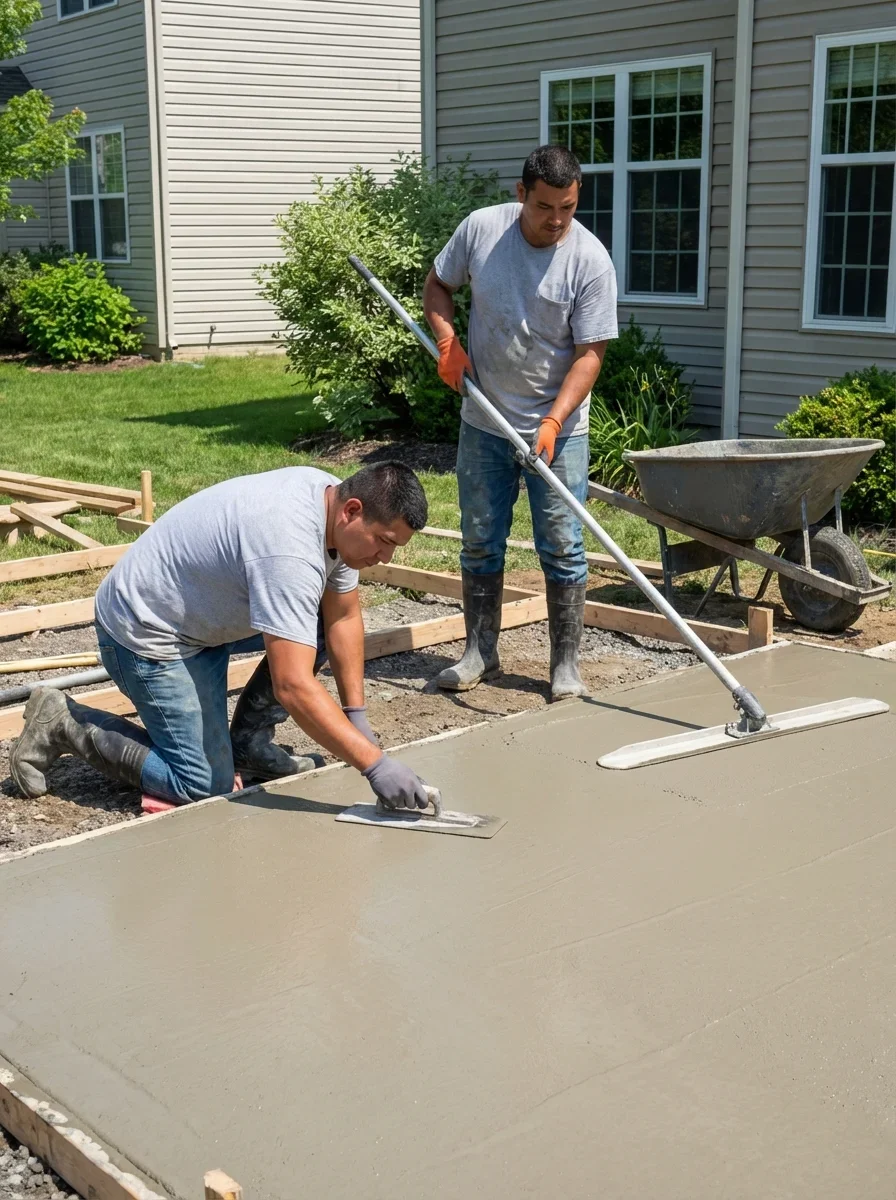
Most concrete contractors offer overlapping core services, though their expertise levels vary by specialty:
- Driveways and parking areas — From simple residential drives to multi-car parking pads with decorative borders
- Patios and outdoor living spaces — Ground-level slabs, raised patios, stamped designs, integrated fire pit areas
- Sidewalks and walkways — Public sidewalk replacement, custom garden paths, ADA-compliant ramps
- Foundation work — Poured walls, monolithic slabs, crawl space floors, structural repairs
- Garage and basement floors — New pours, resurfacing, epoxy-ready prep work
- Concrete repairs — Crack filling, slab leveling, surface restoration, joint sealing
The distinction between services matters when hiring.
A contractor advertising "all concrete services" might subcontract decorative work to a specialist, adding a markup you'd avoid by hiring that specialist directly. Ask specifically about the contractor's experience with your exact project type, not just general concrete work.
How to Choose the Right Contractor for Your Project
Start by matching contractor specialty to project type. Get estimates from residential flatwork specialists for your driveway, not from commercial contractors whose pricing and scheduling revolve around large-scale jobs.
For decorative projects, request portfolio photos showing similar work — stamping quality varies dramatically between contractors.
Verify licensing and insurance independently rather than relying on self-reported credentials. Wisconsin homeowners should confirm contractors rank among licensed professionals in good standing, though even top-rated contractors remind customers to verify insurance coverage directly.[2]
Request detailed written estimates that break down materials, labor, site prep, and finishing separately. Vague lump-sum quotes make it impossible to evaluate fair pricing or understand what you're actually paying for. Line-item estimates also simplify change order discussions if you modify the project scope mid-job.
Check references specifically for projects matching yours in size and complexity.
A contractor with stellar reviews for small repair jobs might lack experience managing a large foundation pour with complex forming requirements. Ask previous customers about communication, timeline accuracy, and how the contractor handled unexpected site conditions.
Pro Tip: Always verify a contractor's experience with your specific project type, not just general concrete work. A contractor excellent at driveways may lack the specialized skills needed for decorative stamping or structural foundation work — and vice versa.
Working Successfully with Your Concrete Contractor
Communication Best Practices
Establish communication preferences upfront — text, phone, email — and confirm who makes decisions if you're unavailable during work hours. Concrete placement can't wait once it starts, so your contractor needs clarity on how to reach you for time-sensitive questions.
Schedule a pre-construction meeting to walk the site together.
Point out underground utilities, irrigation lines, drainage concerns, and any existing damage you want addressed. Discuss realistic timelines given weather dependencies — concrete curing requires maintaining adequate moisture and temperature for at least 7 days, with timelines affected by weather conditions.[2]
Keep a project log documenting conversations about changes, delays, or concerns. Simple dated notes — even text screenshots — prevent misunderstandings about what was agreed verbally. The best contractors appreciate homeowners who document clearly because it protects both parties.
Understanding Your Contract and Payment Terms
Your contract should specify concrete mix design (PSI rating, air entrainment percentage), reinforcement details (rebar size and spacing, wire mesh), and finish type (broom, smooth trowel, stamped pattern).
These specifications directly affect durability and appearance.
Standard payment schedules typically request one-third down to secure scheduling and purchase materials, one-third when work begins, and final payment upon completion. Be cautious of contractors demanding large upfront payments or full payment before project completion.
Top-rated contractors often stand out for honest advice about timing — like suggesting you wait until after foundation repairs settle before pouring adjacent flatwork — even when it delays their payment.
Clarify warranty coverage in writing. Does the contractor guarantee the work against cracking, settling, or finish failures? For how long? What maintenance requirements, if any, affect warranty validity?
Understanding these terms before signing prevents disputes later.
Key Contract Items to Verify:
- Concrete mix specifications (PSI rating, air entrainment percentage)
- Reinforcement details (rebar size/spacing or wire mesh type)
- Finish type and technique (broom, trowel, stamped pattern)
- Payment schedule (typical: 1/3 down, 1/3 at start, 1/3 at completion)
- Warranty duration and coverage specifics
- Maintenance requirements that affect warranty validity
Essential Guides for Homeowners
Wisconsin's concrete season runs heaviest in spring and fall when temperatures support proper curing without extreme heat or cold. Summer work succeeds with proper moisture management, but scheduling books up months in advance as homeowners compete for contractor availability.
Beyond seasonal timing, successful concrete projects require understanding costs, contractor qualifications, material choices, and project-specific techniques.
We've organized comprehensive guides into focused categories addressing common homeowner questions:
- Hiring and vetting contractors — How to verify licensing, check references, compare estimates, and recognize red flags
- Understanding costs — What drives concrete pricing, typical ranges for common projects, budget planning
- Materials and techniques — Concrete mix designs, reinforcement options, decorative finishes, repair methods
- Licensing and regulations — Local permit requirements, Wisconsin contractor licensing, insurance essentials
- Project types — Detailed guides for driveways, patios, foundations, repairs, and specialty applications
Each guide provides specific, actionable information for planning and managing your concrete project from initial research through final curing.
Find Qualified Concrete Contractors in Fox Valley
The difference between a concrete project that lasts decades and one requiring expensive repairs in a few years often comes down to contractor expertise and execution quality.
Take time to research specialists, verify credentials independently, and communicate your expectations clearly.
When you're ready to move forward, connect with licensed concrete contractors serving your area who specialize in the exact type of work you need.
- California Contractors State License Board (CSLB). "Concrete Contractors." https://www.cslb.ca.gov/Contractors/Applicants/Contractors/Concrete_Contractor.aspx. Accessed February 09, 2026.
- Portland Cement Association. "Guide to Concrete Curing." https://www.cement.org/cement-concrete-applications/concrete-construction/curing/. Accessed February 09, 2026.
- American Concrete Institute (ACI). "Concrete Flatwork Finisher Certification." https://www.concrete.org/certification/certificationprograms/flatworkfinisher.aspx. Accessed February 09, 2026.