Common Concrete Driveway Problems in Wisconsin
Wisconsin driveways face a specific set of challenges that homeowners in milder climates don't deal with. Freeze-thaw cycles put constant pressure on concrete, and when water seeps into even small cracks, it expands as it freezes and forces those cracks wider. Do that a hundred times over a winter, and minor surface damage becomes structural problems.
Most driveway issues fall into three categories. Recognizing which one you have determines what kind of contractor you need and whether the concrete can be saved.
Cracking: When It's Serious vs Cosmetic
Fine hairline cracks less than 1/8 inch wide are common in concrete driveways and usually don't indicate structural failure. They're the result of normal concrete shrinkage during curing or minor settling. These can often be sealed to prevent water infiltration, and resurfacing can cover them entirely.
Wider cracks—anything over 1/4 inch or cracks that have vertical displacement—signal a different problem. When one side of a crack sits higher than the other, you're looking at soil settlement or erosion underneath the slab. This isn't something surface treatments fix.
You need either concrete leveling to raise the sunken section or, if the damage is extensive, full replacement of that section. Cracks that form a pattern (like alligatoring or crazing across large sections) often mean the concrete is breaking down internally. This happens when the concrete wasn't properly mixed, was poured in freezing temperatures, or has simply reached the end of its useful life.
Sinking and Uneven Sections
When part of your driveway sits noticeably lower than it used to—creating a trip hazard or pooling water—the concrete itself might be fine. The soil underneath has shifted or washed away.
This happens frequently near downspouts, where water saturates the ground, or in areas with clay soil that expands and contracts seasonally. Concrete leveling contractors specialize in fixing this exact problem. They don't replace the concrete; they lift it back into position by pumping material underneath to fill the voids. The process takes hours instead of days, and you can drive on it almost immediately.
Replacement only makes sense here if the settling has caused the concrete to crack so severely that lifting it would just break it further. A good contractor will tell you honestly whether your slab can handle the leveling process or if it's too compromised.
Surface Deterioration and Scaling
Surface scaling—where the top layer of concrete flakes off in thin sheets—is almost always a winter problem. It happens when de-icing salts pull moisture to the surface, and repeated freeze-thaw cycles pop off the top layer. You'll see it most often near the street where salt concentrations are highest.
Moderate scaling is a perfect candidate for resurfacing. Contractors remove the damaged layer and apply a new concrete overlay that bonds to the existing slab. You get a fresh surface without the cost of demolition and replacement.
Once scaling exposes aggregate or goes deeper than about 1/4 inch across large sections, you're looking at concrete that's been compromised throughout. At that point, resurfacing is just covering up structural failure, and the new surface won't last.
Quick Reference: Driveway Problem Severity
- Hairline cracks (<1/8"): Cosmetic, easily sealed, good for resurfacing
- Wide cracks (>1/4"): Structural concern, may need leveling or replacement
- Vertical displacement: Soil settlement issue, requires leveling first
- Surface scaling (<1/4" deep): Repairable with resurfacing overlay
- Deep scaling (>1/4" deep): Indicates concrete breakdown, likely needs replacement
- Isolated sinking sections: Usually fixable with concrete leveling
- Multiple problem types: May indicate driveway approaching end of lifespan
Should You Repair or Replace Your Driveway?
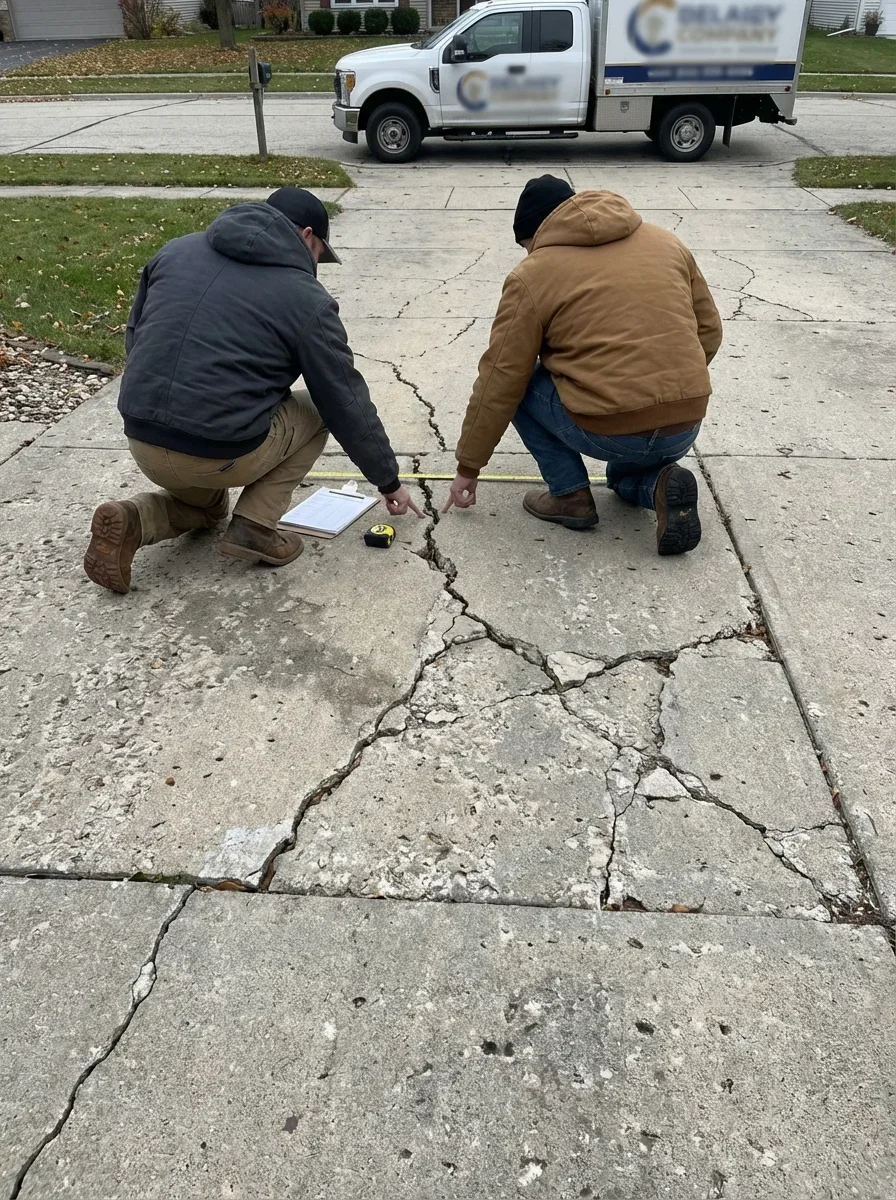
The decision comes down to three factors: the type of damage, how much of the driveway is affected, and how old the concrete is. A driveway that's only 10 years old with isolated settlement issues is worth saving. A 30-year-old driveway with multiple large cracks, significant scaling, and uneven sections is telling you it's reached the end of its lifespan.
Surface damage responds to repair; structural failure throughout the slab doesn't. If your problems are limited to one area—a sunken section near the garage, cracks along one side, or surface deterioration in a specific zone—repair makes economic sense. When multiple types of damage appear across the entire driveway, replacement costs start to make more sense than piecing together repairs.
Age matters because concrete has a functional lifespan of about 25-30 years in Wisconsin's climate, assuming it was properly installed. If your driveway is approaching that age and showing multiple problems, investing in extensive repairs just delays the inevitable. You'll end up paying for repairs now and replacement in a few years anyway.
But a 12-year-old driveway with fixable issues? Worth repairing.
The extent of damage is the clearest deciding factor. As a general rule, if more than 30-40% of your driveway needs significant work, replacement becomes cost-competitive with comprehensive repairs. Contractors can give you a square-footage breakdown comparing repair costs to replacement costs for your specific situation.
Professional Driveway Repair Options
Professional concrete contractors have methods that go far beyond patching cracks with tube sealant from the hardware store. The techniques they use address what caused the damage in the first place, which is why professional repairs last years instead of months.
Concrete Resurfacing: Process and Cost
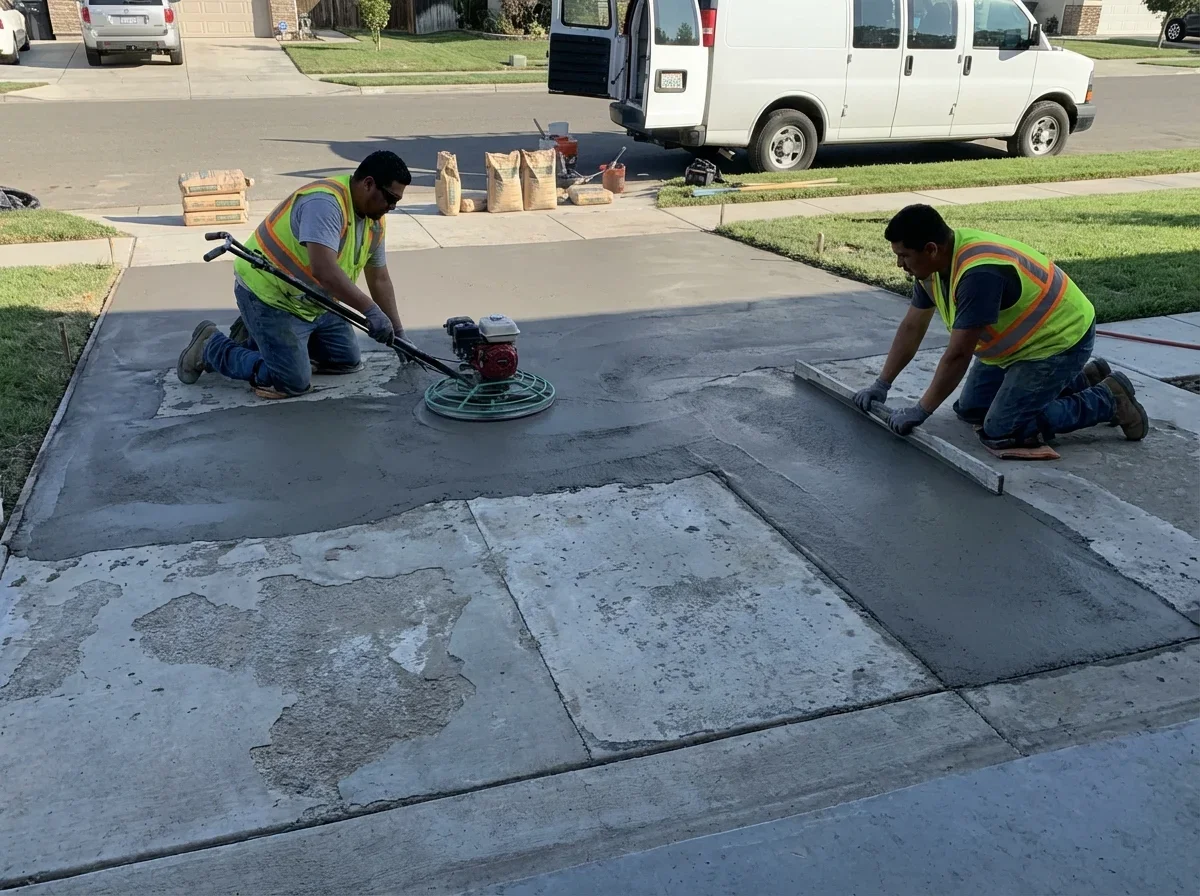
Resurfacing applies a new layer of concrete (typically 1/4 to 1/2 inch thick) over your existing driveway. Contractors use polymer-modified overlays that bond chemically and mechanically to the old surface, creating what's effectively a new driveway surface on top of your existing structural base.
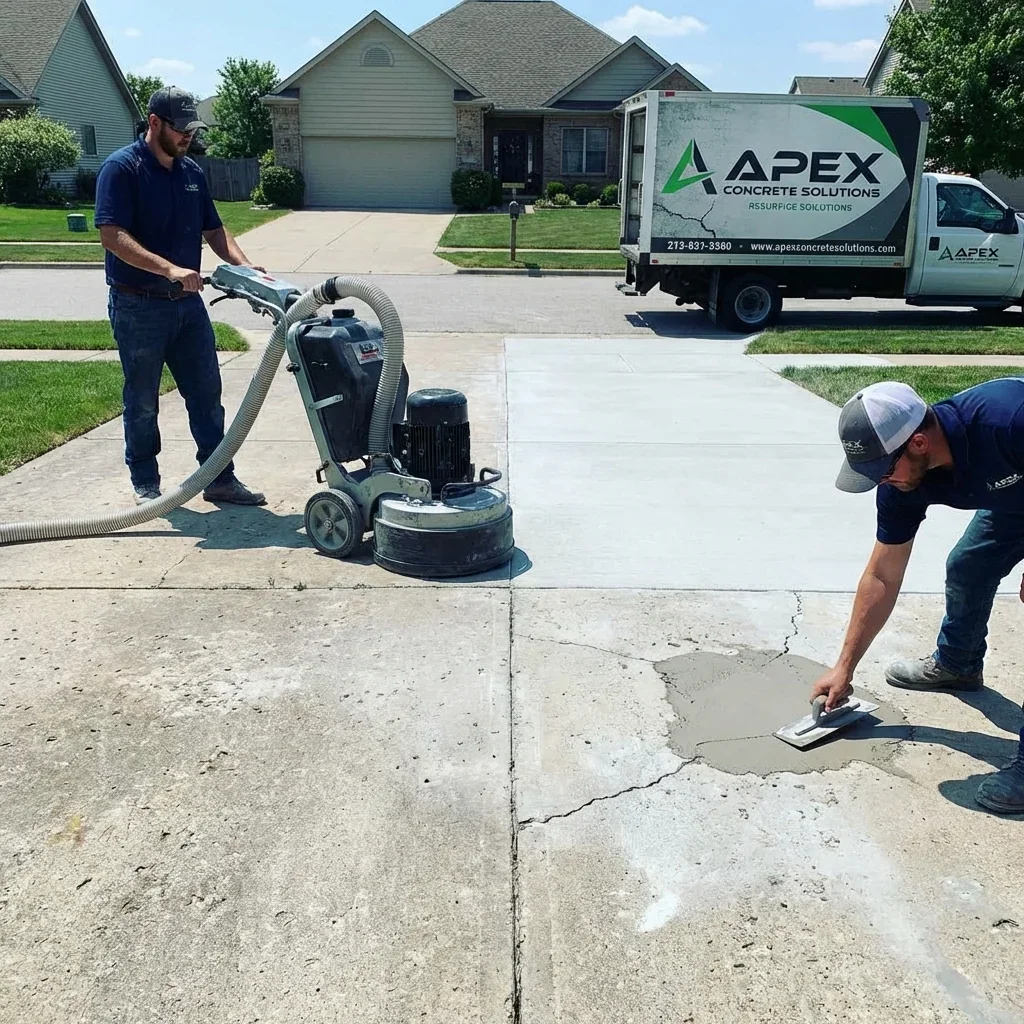
The process starts with cleaning and profiling the existing concrete—removing any loose material and creating a texture the overlay can grip. Contractors then fill larger cracks and depressions before applying the overlay material. Most systems can be stamped or colored, so you're not limited to plain gray concrete.
Resurfacing costs typically run $3-7 per square foot, depending on the overlay system and any decorative options. For a standard two-car driveway (around 600 square feet), you're looking at $1,800-4,200. That's roughly half the cost of full replacement, and the work takes 1-2 days instead of a week.
This only works when the underlying concrete is structurally sound. If you have significant settling, large areas of deep cracking, or sections that move when you drive on them, the overlay won't fix those issues.
Resurfacing contractors should inspect your base and tell you honestly if your slab is a good candidate.
Driveway Leveling: Mudjacking vs Foam Injection
Both mudjacking and polyurethane foam injection lift sunken concrete by pumping material underneath the slab. The difference is what they pump and how precisely they can control the lift.
Mudjacking (also called slabjacking) uses a slurry mixture of cement, sand, and additives. Contractors drill 2-inch holes through the concrete, pump the slurry underneath until the slab lifts to the desired height, then patch the holes. It's been the standard leveling method for decades and works well for most applications.
The material adds significant weight, though, so it's not ideal for areas with soft soil that caused the settling in the first place. Foam injection uses expanding polyurethane foam that's much lighter and expands more predictably. Contractors drill smaller holes (usually 5/8 inch), inject the foam, and can control the lift more precisely by watching the slab rise in real time. The foam cures in minutes instead of hours, and its light weight won't compress soft soils further.
Cost-wise, mudjacking typically runs $5-8 per square foot of lifted area, while foam injection costs $8-15 per square foot. The price gap reflects the material cost and precision of the foam system. For a typical sunken driveway section (100-150 square feet), expect $500-800 for mudjacking or $800-1,500 for foam injection.
Concrete leveling contractors can often complete the work in a few hours, and you can drive on it the same day. It's dramatically faster and less expensive than replacing the affected section, assuming the concrete isn't too deteriorated to hold together during the lift.
| Feature | Mudjacking | Foam Injection |
|---|---|---|
| Material | Cement/sand slurry | Polyurethane foam |
| Hole Size | 2 inches | 5/8 inch |
| Weight | Heavy (adds load to soil) | Ultra-light (3-4 lbs per cubic ft) |
| Cure Time | 24-48 hours | 15 minutes |
| Precision | Moderate lift control | High precision, real-time adjustment |
| Cost per Sq Ft | $5-8 | $8-15 |
| Best For | Stable soil, budget projects | Soft soil, precise leveling needs |
Crack Repair Methods Contractors Use
Professional crack repair depends on the crack width and whether it's active (still moving) or dormant. For narrow cracks up to about 1/4 inch, contractors typically use routing and sealing—they widen the crack with a grinder to create a reservoir, clean it thoroughly, then fill it with flexible polyurethane or silicone sealant that can accommodate minor movement.
Wider cracks or those with vertical displacement might get epoxy injection. Contractors seal the surface of the crack, drill injection ports along its length, then pump in epoxy resin under pressure to fill the crack from bottom to top. The epoxy bonds the two sides together and is stronger than the surrounding concrete.
This works for dormant cracks but will fail if the underlying cause (like continuing settlement) isn't addressed. Full-depth repair cuts out the damaged section entirely and replaces it with new concrete. Contractors saw cut around the damaged area, remove the broken concrete, address any base problems, then pour new concrete tied to the existing slab with dowels or reinforcement. This is a mini-replacement and costs accordingly—typically $8-15 per square foot depending on depth and access.
The right method depends on what caused the crack. Settlement cracks need the settlement fixed first, or any repair will just crack again. Shrinkage cracks from curing can be filled and forgotten. A good contractor diagnoses the cause before recommending a solution.
What Does Driveway Repair Cost?
Repair costs vary widely based on which method your driveway needs and how much area requires work. The good news is that most repairs cost a fraction of replacement, which typically runs $8-15 per square foot for removal and new installation.
For resurfacing an entire driveway, budget $3-7 per square foot. A 600-square-foot two-car driveway would cost $1,800-4,200 to resurface versus $4,800-9,000 to replace.
The cost increases if you add decorative stamps, color, or borders, but you're still well below replacement costs. Concrete leveling charges by the area lifted, not the total driveway size. Lifting a 100-square-foot sunken section costs $500-1,500 depending on the method (mudjacking vs foam). Replacing that same section would cost $800-1,500 just for materials and labor, plus you'd lose use of the driveway for several days while the new concrete cures.
Crack repair costs depend on length and severity. Simple routing and sealing runs $3-6 per linear foot, so fixing a 20-foot crack costs $60-120. Epoxy injection for structural cracks costs $10-20 per linear foot. Full-depth crack repair that involves removing and replacing concrete runs $8-15 per square foot of the affected area.
Most contractors have minimum charges ($300-500) since mobilizing equipment and small crews costs them money regardless of job size. This means tiny repair jobs might not save you much compared to slightly more comprehensive work. Get quotes for different scope options—sometimes fixing multiple issues at once is more economical than addressing them one at a time over several years.
How to Choose a Driveway Repair Contractor
Not all concrete contractors do repair work well. Pouring new driveways is straightforward compared to diagnosing existing damage and choosing the right fix.
You want someone with specific experience in resurfacing, leveling, or whatever repair method your driveway needs. Start with a thorough inspection. A quality contractor examines the entire driveway, not just the obvious problem area. They'll look for patterns in the cracking, check for settlement in multiple spots, and test sections to see how sound the existing concrete is. They should be able to explain what caused your specific damage and why their recommended solution addresses the root cause.
Ask about their repair methods specifically. If they recommend resurfacing, what overlay system do they use? If leveling, do they use mudjacking or foam, and why do they think one is better for your situation?
Contractors who only know one method will try to make every problem fit that solution. You want someone with multiple techniques who matches the method to your specific damage.
Warranty coverage matters more for repairs than new installation. A new driveway warranty covers materials and workmanship against defects. A repair warranty needs to cover the repair holding up under the same conditions that damaged the original concrete. Look for at least 2-5 years on resurfacing work and 1-3 years on leveling, with clear terms about what's covered.
References from recent repair jobs tell you more than references from new pours. Ask to see photos of similar repairs the contractor completed 2-3 years ago, or ask for contact information from customers who had work done a few years back.
If those repairs are still holding up, you've found someone who understands lasting solutions.
Pro Tip: Before hiring any contractor, ask them to walk your entire driveway and explain what they see—not just the obvious damage, but the patterns and root causes. A contractor who can diagnose WHY your driveway failed will deliver repairs that actually last, while one who just quotes a fix for the visible symptoms will have you calling again in two years.
Find Qualified Repair Contractors Near You
The right repair contractor can save you thousands compared to premature replacement and add years to your driveway's lifespan. Compare quotes from concrete resurfacing contractors and concrete leveling contractors who specialize in the specific work your driveway needs.