How Modern Concrete Technology Has Changed the Industry
Concrete work used to mean heavy labor, lengthy cure times, and limited design options. Today's contractors employ technologies that speed up timelines, reduce manual labor, and deliver finishes that were once considered specialty work.
Self-consolidating mixes eliminate the need for vibration equipment, fiber reinforcements replace traditional rebar in certain applications, and computer-controlled grinding systems create polished floors with glass-like clarity.
These changes matter for homeowners because they directly affect project costs, durability, and what's possible aesthetically. A contractor using laser screeding equipment can achieve flatness tolerances impossible with manual methods. One using rapid-set formulations might complete your driveway in a day instead of a weekend.
Understanding these capabilities helps you distinguish between contractors working with outdated methods and those investing in current technology.
The shift toward advanced techniques also changes how contractors price work. Equipment like ride-on power trowels or diamond grinding systems represents significant capital investment, but that investment translates to better results and often faster completion. When you see price differences between quotes, you're often seeing the gap between hand tools and specialized machinery.
Advanced Mixing and Pouring Techniques
Self-Consolidating Concrete
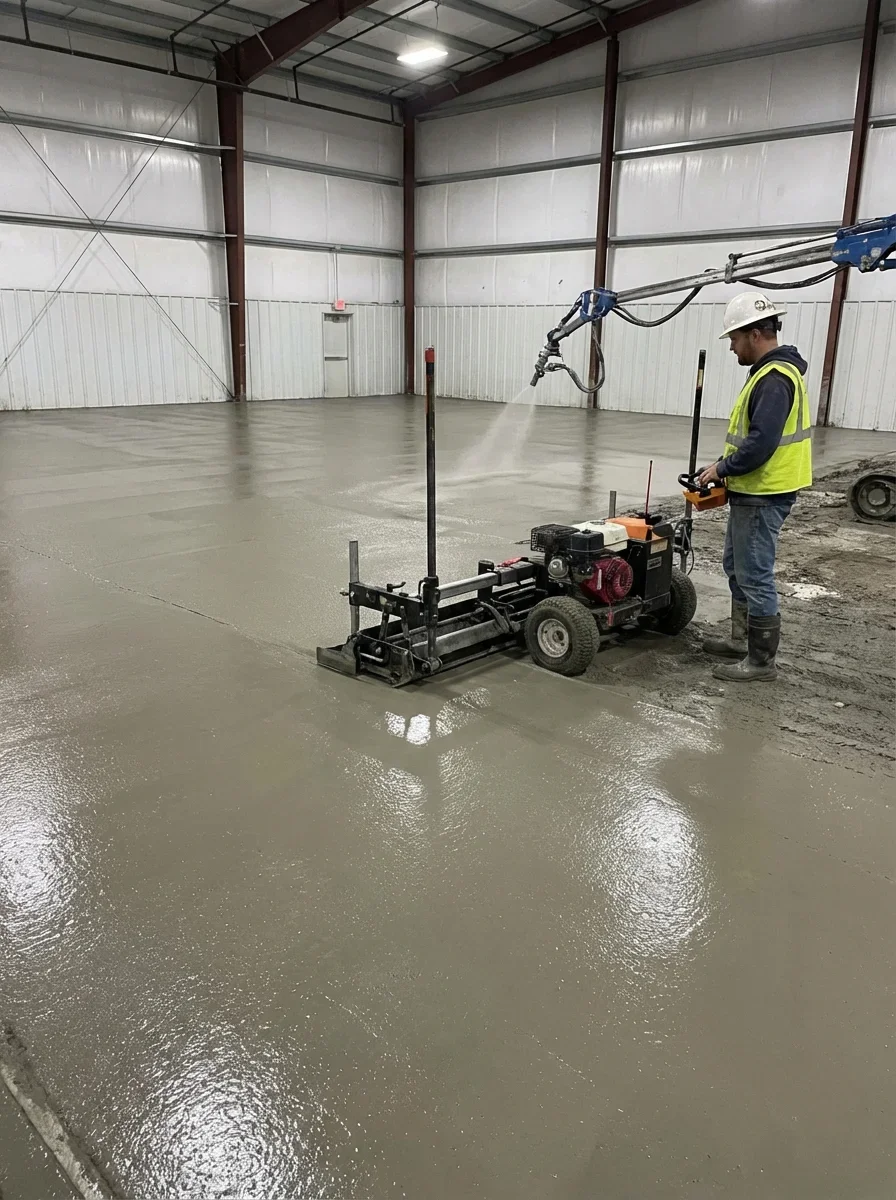
Self-consolidating concrete (SCC) flows into forms without mechanical vibration, filling complex shapes and tight spaces through gravity alone.[1] Contractors use this for projects with heavy reinforcement, intricate formwork, or areas where traditional vibration equipment can't reach.
Faster pours with fewer workers.
A contractor doesn't need someone operating a vibrator throughout the pour, which reduces labor costs and speeds up placement. You'll see SCC recommended for decorative walls with detailed patterns, columns, or areas with congested rebar layouts where traditional concrete would trap air pockets.
SCC costs more per cubic yard than standard mixes due to specialized admixtures and tighter quality control during batching. Contractors reserve it for situations where the labor savings justify the material premium or where achieving proper consolidation with conventional methods would be difficult.
Fiber-Reinforced Systems
Fiber-reinforced concrete incorporates synthetic or steel fibers throughout the mix, providing tensile strength and crack control without traditional rebar grids.[2] For residential slabs-on-ground, driveways, and overlays, fibers can replace welded wire mesh entirely. No more time spent cutting, placing, and securing metal reinforcement.
Contractors use different fiber types depending on the application. Synthetic macro-fibers work well for residential flatwork, controlling plastic shrinkage cracks and providing post-crack load capacity. Steel fibers deliver higher tensile strength for industrial floors or areas expecting heavy point loads.
The installation advantage is significant — no waiting for rebar placement means faster pours and one less trade to coordinate. You won't see exposed rebar at edges or corners where wire mesh sometimes shows through. For overlays and micro-toppings, fibers integrate seamlessly at thicknesses where traditional reinforcement wouldn't fit.
Not every application suits fiber reinforcement. Structural elements and heavily loaded suspended slabs still require conventional rebar. But for many residential projects, fibers deliver equivalent or superior performance with simpler installation.
Eco-Friendly and Permeable Concrete
Permeable concrete creates void structures that allow water to drain through the surface, managing stormwater on-site rather than directing it to storm sewers. Contractors install this for driveways, patios, and walkways where stormwater management matters — either for regulatory compliance or to prevent pooling and runoff erosion.
The technology involves carefully controlled aggregate gradations and cement paste proportions to create interconnected voids, achieving drainage rates of 3-8 gallons per square foot per minute. You'll sacrifice some surface smoothness compared to traditional concrete, but modern installation techniques minimize the coarse appearance that gave early permeable concrete a rough reputation.
Eco-friendly mixes go beyond permeability. Contractors now access concrete incorporating recycled aggregates, supplementary cementitious materials like fly ash or slag cement, and carbon-sequestering admixtures. These reduce embodied carbon and can contribute to green building certifications if you're pursuing LEED or similar standards.
Expect higher upfront costs — permeable concrete runs 20-30% more than conventional concrete when accounting for specialized installation requirements and subbase preparation.
| Concrete Type | Best Applications | Key Advantage | Cost Premium |
|---|---|---|---|
| Self-Consolidating | Complex forms, heavy reinforcement areas, decorative walls | Flows without vibration, faster placement | 15-25% higher material cost |
| Fiber-Reinforced | Residential slabs, driveways, thin overlays | Eliminates rebar installation time | 10-15% higher material cost |
| Permeable | Driveways, patios, stormwater management areas | On-site water drainage, eco-friendly | 20-30% higher total cost |
| Standard Mix | Basic structural work, foundations, simple slabs | Lowest cost, widely available | Baseline pricing |
Cutting-Edge Decorative Concrete Methods
3D Stamping and Texturing Technology
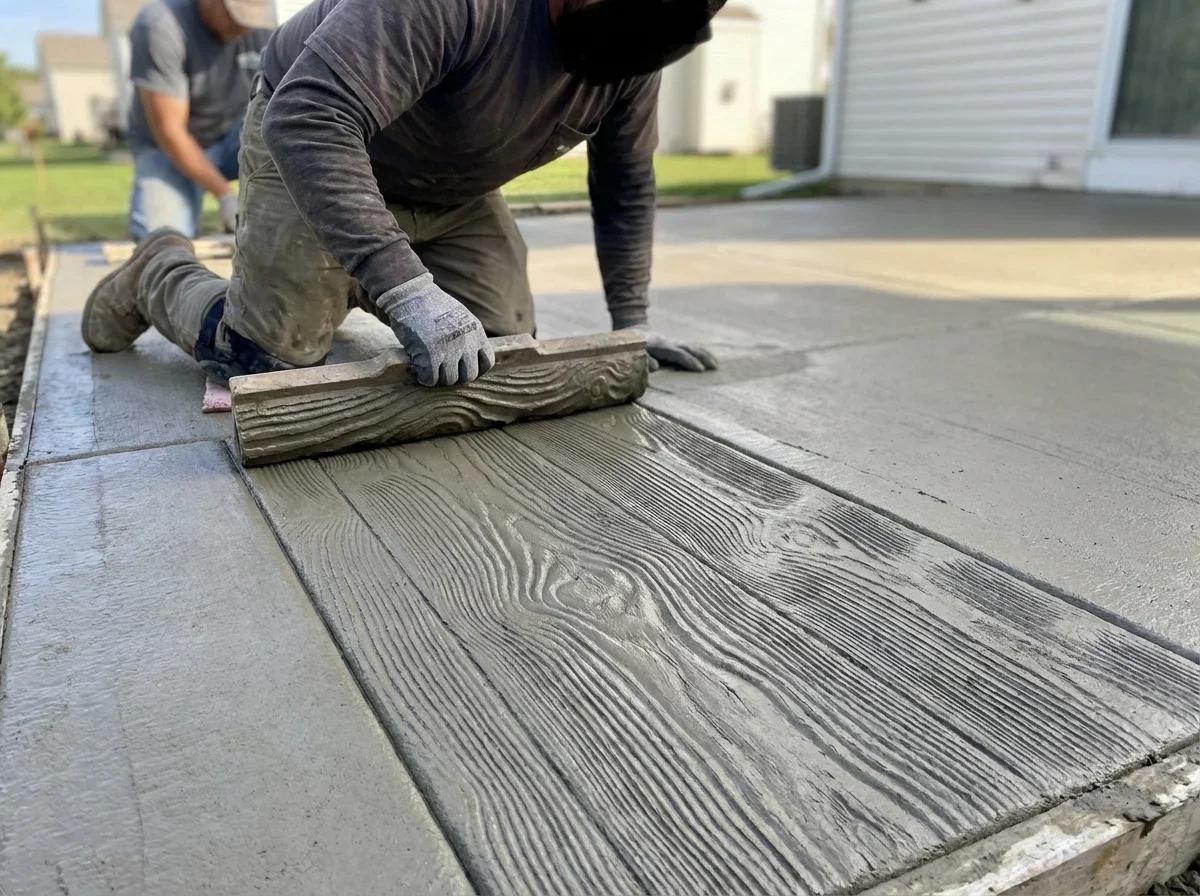
Modern stamping has evolved from basic brick patterns pressed into wet concrete. Today's contractors use rigid 3D texturing skins that replicate stone, wood, and tile with depth and realism that earlier flexible stamps couldn't achieve. These systems create seamless patterns across large areas without the repetitive appearance that gave stamped concrete a "fake" reputation.
The texturing skins are laser-scanned from actual materials — real flagstone, weathered wood planks, natural slate. They capture surface irregularities, grout lines, and texture variations. Contractors apply these after the concrete reaches the proper set stage, using specialized release agents that create color variation mimicking natural material.
Installation requires timing precision. Apply the texture too early and the concrete deforms. Wait too long and the pattern won't transfer.
Experienced contractors read the concrete's state by touch and environmental conditions, adjusting application timing for temperature and humidity. You'll see the best results from contractors who've invested in extensive texture libraries and understand how different release agents interact with integral colors to create authentic color variation.
Advanced Polishing and Finishing Systems
Polished concrete technology uses progressively finer diamond abrasives and chemical densifiers to transform poured slabs into glossy, marble-like surfaces.[3] Contractors achieve this through multi-step grinding — starting with 30-grit metal-bonded diamonds to remove surface imperfections, progressing through 400 or 800 grit for satin finishes, or continuing to 1500-3000 grit for high-gloss results.
Chemical densifiers penetrate the concrete surface, reacting with free lime to create additional calcium silicate hydrate. This hardens the surface, reduces dusting, and creates the glass-like clarity that defines polished concrete.
The technology delivers abrasion resistance suitable for high-traffic residential areas like kitchens and living spaces while eliminating the need for topical coatings that wear and require reapplication.
The equipment investment separates professional polishing from amateur attempts. Planetary grinders with multiple rotating heads cut flat and eliminate lippage between panels. Dust extraction systems meeting OSHA silica regulations protect workers and keep your home clean during the process. Contractors who own this equipment can polish existing slabs or new pours, though new concrete offers more control over aggregate exposure and final appearance.
Modern Color and Staining Options
Integral color technology has advanced beyond the limited, often garish palette that characterized early colored concrete. UV-stable pigments now resist fading under sunlight exposure. Contractors can match any color specification through custom batching.
Acid stains — the traditional method creating variegated earth tones through chemical reactions with concrete — now compete with newer water-based reactive stains and acetone dyes. These alternatives offer broader color ranges and more predictable results. Water-based stains don't produce the fumes associated with acid stains, making them practical for interior applications without extensive ventilation.
Contractors often combine techniques. Integral color throughout the mix for base tone. Surface stains for depth and variation. Antiquing releases for highlighting texture.
The layering creates complexity and natural appearance impossible with single-method coloring. Expect higher costs for multi-layer color systems, but the visual result separates premium decorative concrete from basic tinted slabs.
Decorative Overlays and Micro-Toppings
Overlays transform worn concrete without removal and replacement. Contractors apply polymer-modified toppings as thin as ¼ inch over existing surfaces, correcting minor imperfections and providing fresh surfaces for stamping, staining, or polishing.
Modern micro-toppings bond mechanically and chemically to properly prepared substrates, achieving compressive strengths exceeding 6,000 psi despite minimal thickness. Contractors use these for resurfacing cracked driveways, dated patios, and stained garage floors.
The preparation work determines success. Surfaces require thorough cleaning, crack repair, and often mechanical scarification or shot blasting to create adequate profile.
You'll see overlays recommended when your existing concrete has sound structural integrity but cosmetic issues. Spalling, surface cracks, and discoloration all suit overlay repair. Deep structural cracks, settlement issues, or severe deterioration don't — those require removal and replacement regardless of overlay capabilities.
Contractors experienced with overlays assess substrate conditions carefully. Overlay failure almost always traces to inadequate preparation or inappropriate application over unsuitable surfaces.
Pro Tip: Overlay success depends 80% on surface preparation and only 20% on the topping material itself. A contractor who rushes preparation to save time will deliver results that fail within months. Always ask about their prep process — shot blasting, acid etching, and proper cleaning should be standard, not optional.
Equipment and Tools That Separate Top Contractors
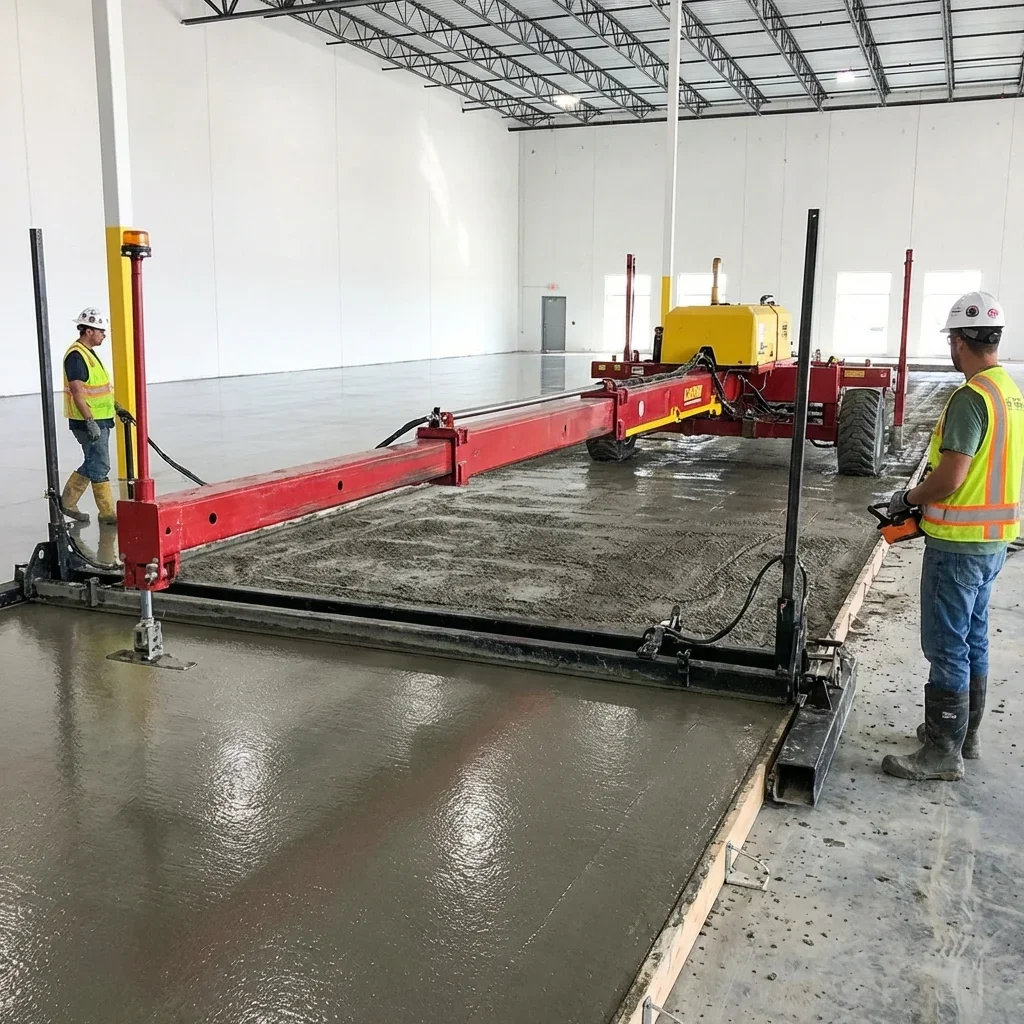
Laser-guided screeding systems represent significant contractor investment — often $15,000-$30,000 for complete setups. These deliver flatness tolerances measured in fractions of an inch across entire slabs, critical for polished floors where slight deviations show clearly and for garage floors where drainage patterns matter.
The technology uses grade lasers and screed receivers that automatically adjust blade height, maintaining precise elevation as the screed travels across fresh concrete. Manual screeding relies on operator skill and preset guide rails. Laser screeding removes human variability from the flatness equation.
You'll notice the difference in final results — machine-finished floors need minimal grinding for polished applications and show no visible high or low spots.
Ride-on power trowels finish large areas faster and flatter than walk-behind machines. Contractors use these for garage floors, basement slabs, and commercial-sized residential projects where manual finishing would take hours. The machines' weight and multiple rotating blades densify the surface more effectively than hand troweling, creating harder, more abrasion-resistant finished concrete.
Polyurethane foam injection equipment lifts sunken concrete sections without removal — a modern alternative to full replacement that many homeowners discover after the fact. The technology works for settled driveway sections, sunken patio slabs, and unlevel walkways. Contractors drill small holes, inject expanding foam beneath the slab, and precisely lift sections back to grade.
The process takes hours instead of days, leaves minimal visible repair marks, and costs 50-70% less than replacement. Many contractors offer warranties around five years for foam lifting work, providing protection against resettlement.
Should You Invest in These Advanced Techniques?
Premium concrete technologies make sense when you're prioritizing specific outcomes — exceptional durability, complex aesthetics, faster timelines, or long-term cost efficiency. A basic driveway pour might not justify self-consolidating concrete or fiber reinforcement. But an exposed aggregate patio with intricate borders and embedded stone patterns might benefit from both.
Start by clarifying your priorities. If you're building a polished concrete floor in your main living space, investing in a contractor with professional grinding equipment and densifying systems delivers results you can't achieve with basic finishing tools. If you need a utilitarian garage slab poured quickly, rapid-set formulations might justify their premium cost by getting you back in use the same day.
Ask contractors which techniques they're recommending and why.
Detailed estimates breaking down labor and materials from at least three contractors reveal where advanced methods affect pricing and what you're paying for. A contractor using laser screeding charges more for equipment but potentially less for labor since the technology speeds work. One proposing fiber-reinforced concrete might have higher material costs but lower installation time compared to traditional rebar placement.
Request warranties in writing for both labor and materials. Advanced techniques should come with contractor confidence — if someone's proposing premium methods, they should stand behind the results with warranty coverage addressing potential issues. This protects you whether it's polished concrete requiring repolishing due to improper densifier application or stamped surfaces showing premature pattern degradation.
Key Factors When Evaluating Advanced Concrete Techniques:
- Project timeline: Rapid-set formulas and efficient equipment can cut completion time by 50-70%
- Long-term maintenance: Polished concrete and sealed surfaces reduce ongoing maintenance versus traditional finishes
- Climate considerations: Permeable concrete and fiber reinforcement perform differently in freeze-thaw climates
- Aesthetic goals: 3D stamping and advanced coloring justify premium costs for visible, high-impact areas
- Budget flexibility: Advanced techniques cost 20-40% more upfront but often deliver better value over 10+ years
- Resale value: Premium decorative finishes and polished floors appeal to buyers in mid-to-high-end markets
Find Contractors Who Offer Modern Concrete Technologies
Not every concrete contractor invests in advanced equipment or stays current with emerging techniques. The industry includes specialists focused on decorative work, others emphasizing structural expertise, and general contractors handling basic flatwork.
Review contractor portfolios for projects similar to yours. A contractor showing extensive polished concrete installations demonstrates equipment ownership and technique mastery. One displaying varied stamping patterns and texturing proves capability with decorative systems.
Portfolio review reveals specialization before you invest time in consultations.
Verify licensing and insurance through your state's contractor licensing board. Ask about the techniques you're considering — which equipment they own versus rent, how long they've been using specific methods, and whether they've completed manufacturer training for proprietary systems like particular overlay products or stamping skin technologies.
Local contractors familiar with your climate understand regional considerations — freeze-thaw durability, local aggregate availability, and seasonal installation constraints. These factors affect mix design, curing procedures, and timing recommendations. A contractor experienced with your area's weather patterns will specify appropriate air entrainment, recommend optimal installation windows, and select decorative techniques suited to your climate's demands.
Responsiveness during initial contact predicts communication throughout your project. Contractors who answer questions thoroughly, explain technique recommendations clearly, and provide detailed written proposals tend to maintain that communication standard during construction.
Specialists in advanced techniques should welcome technical questions — their expertise is part of what justifies premium pricing.
- Federal Highway Administration (FHWA), U.S. Department of Transportation. "FHWA Self-Consolidating Concrete for Precast Elements." https://www.fhwa.dot.gov/publications/research/infrastructure/structures/13027/13027.pdf. Accessed February 09, 2026.
- Fiber Reinforced Concrete Association (FRCA). "Fiber Reinforced Concrete Association Guidelines." https://www.fiberreinforcedconcrete.org/resources/. Accessed February 09, 2026.
- American Concrete Institute (ACI). "Guide to Durable Concrete (ACI 201.2R)." https://www.concrete.org/store/productdetail.aspx?ItemID=2012R18. Accessed February 09, 2026.