What Qualifications Should Your Concrete Contractor Have?
Start with the non-negotiables. Every legitimate concrete contractor needs proper licensing, insurance, and verifiable experience.
These aren't bureaucratic hoops — they're the safety net between you and financial disaster if something goes wrong on your property.
Licensing and Insurance Requirements
In Wisconsin, contractors working on residential projects must hold a Dwelling Contractor certification from the Department of Safety and Professional Services.[1] This certification requires proof of workers' compensation coverage, unemployment compensation compliance, and financial responsibility through either a bond or general liability insurance.[1]
If your contractor can't produce this documentation immediately, that's your first red flag.
General liability insurance protects you if a crew member accidentally damages your gas line, cracks your foundation wall, or drops equipment through a window. Workers' compensation covers medical bills and lost wages if someone gets hurt on your property. Without both, you could be personally liable for injuries or property damage that occurs during your project.
A reputable contractor won't just have this coverage — they'll offer to provide certificates of insurance naming you as an additional insured before work begins.
Some contractors operate as sole proprietors without employees, which changes the workers' comp requirement. Ask directly about their business structure and request documentation either way. The Wisconsin Builders Association notes that the individual serving as the Dwelling Contractor Qualifier must complete 12 hours of approved initial training in dwelling construction,[2] ensuring at least one person on the team understands code requirements and proper building practices.
Must-Have Contractor Credentials:
- Dwelling Contractor certification (Wisconsin DSPS)
- General liability insurance with you named as additional insured
- Workers' compensation coverage (or documented sole proprietor exception)
- Proof of unemployment compensation compliance
- Financial responsibility bond or equivalent coverage
- 12+ hours approved training in dwelling construction
Experience That Matches Your Project Type
A contractor who excels at pouring basement floors might botch your stamped patio. Each requires different skills, equipment, and finishing techniques.
Ask how many projects similar to yours the contractor has completed in the past two years. A vague "we do all kinds of concrete work" should concern you. You want someone who regularly tackles your specific project type and can show you photos of completed work that matches what you're planning.
Better yet, ask for addresses of local projects you can drive by to see how the work has held up over time.
Watch for contractors who specialize so narrowly they can't adapt to site conditions. The best residential contractors combine deep expertise in a few areas with enough versatility to handle unexpected challenges. If your driveway project uncovers drainage issues, you need someone who understands grading and can adjust the plan without calling in three subcontractors.
How to Verify Contractor Credentials
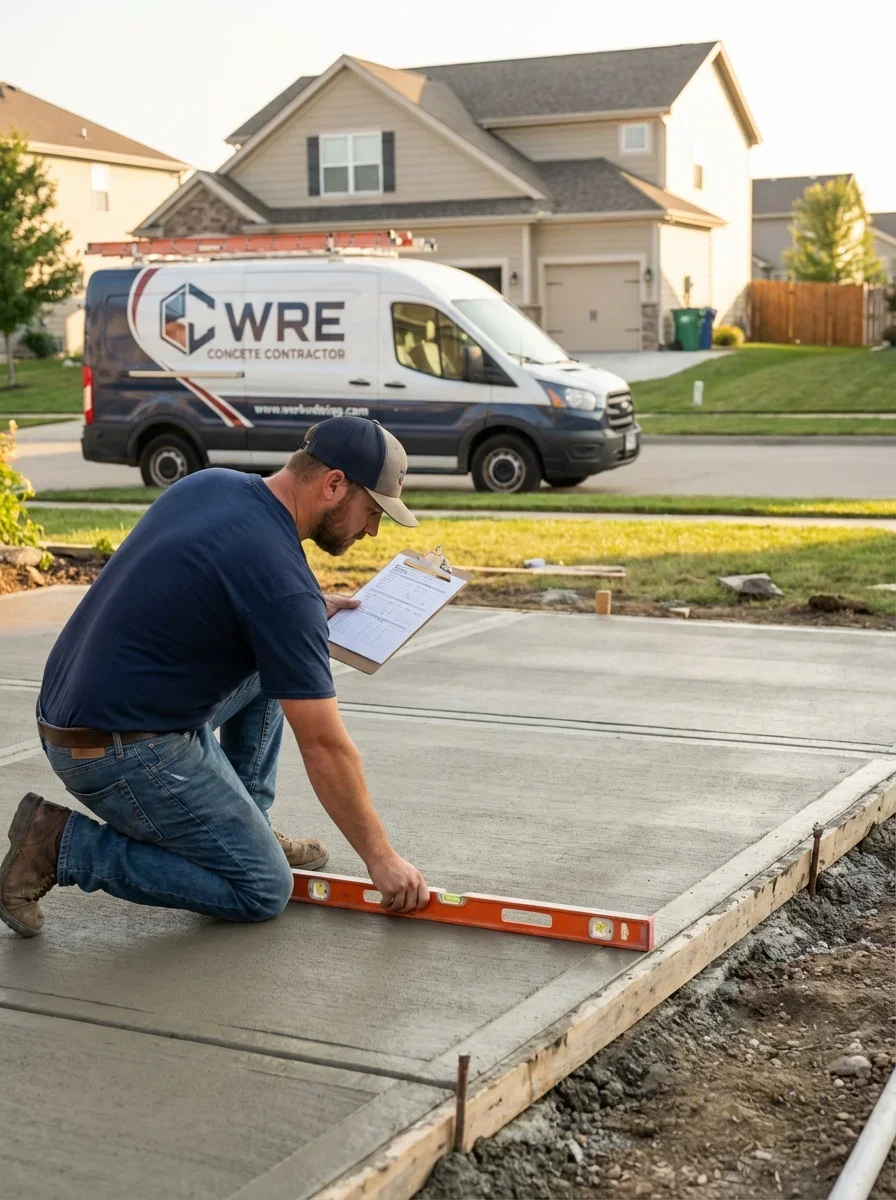
Don't just take a contractor's word that they're licensed and insured. Verify everything before you sign a contract or hand over a deposit.
Start with the Wisconsin DSPS license lookup tool on their website. Enter the contractor's business name or license number to confirm their Dwelling Contractor certification is current and check for any disciplinary actions. This takes five minutes and catches contractors who let their credentials lapse or who've faced complaints serious enough to result in state action.
Next, request certificates of insurance directly from the contractor. A legitimate business will provide these within 24 hours, usually the same day. The certificate should show current coverage with policy expiration dates at least several months out.
If a contractor claims to have insurance but can't produce proof, walk away.
Some homeowners call the insurance company directly to verify coverage. The phone number is on the certificate. This catches forged documents and contractors who had coverage when they got the certificate but let it lapse since then. Making one awkward phone call upfront beats discovering a contractor is uninsured after they've already cracked your foundation.
Check online reviews, but read between the lines. Look for patterns in complaints rather than isolated incidents. Everyone has an occasional unhappy customer, but if multiple reviews mention the same problem — uneven finishes, poor communication, surprise charges — that's meaningful data.
Pay special attention to how the contractor responds to negative reviews. Defensive, combative responses tell you how they'll handle problems on your project.
Essential Questions to Ask Before Hiring
The questions you ask reveal as much about a contractor as their answers do. A professional welcomes detailed questions because they know informed clients make better partners.
Someone who bristles at basic inquiries about their process is telling you they don't want scrutiny.
About Their Process and Materials
Ask what concrete mix design they plan to use for your project. The answer should be specific: PSI rating, air entrainment percentage for freeze-thaw resistance, and aggregate size. If they can't explain why they're recommending a particular mix for your application, they're either inexperienced or cutting corners with whatever's cheapest that day.
Find out how they handle site preparation. Proper concrete work starts below the surface with adequate excavation, compacted base material, and correct grading for drainage. A contractor who glosses over prep work is setting you up for failure.
The concrete might look fine initially, but settling, cracking, and drainage problems will appear within a year or two.
Ask about curing procedures and timeline. Concrete gains strength as it cures, and rushing this process produces weak, crack-prone results. Your contractor should explain their curing method — whether they use curing blankets, sealers, or water — and tell you how long before you can use the surface. Be skeptical of anyone who says you can park on a new driveway the next day.
| Curing Method | Cost Impact | Best For | Timeline to Use |
|---|---|---|---|
| Curing Blankets | +$100-300 | Cold weather pours, accelerated projects | 3-5 days (light use) |
| Chemical Sealers | +$0.15-0.30/sq ft | Hot weather, large areas, long-term protection | 5-7 days (light use) |
| Water Curing | Minimal (labor only) | Ideal conditions, smaller projects | 7-10 days (light use) |
| No Curing | $0 (poor practice) | Never recommended | Higher crack risk regardless |
About Timeline and Crew
Get a realistic timeline with weather contingencies built in. Concrete work depends on temperature and moisture conditions, so a contractor who promises firm dates without mentioning weather is either inexperienced or lying.
Ask what happens if rain delays the pour or temperatures drop below acceptable ranges. You want someone who prioritizes quality over speed.
Find out who will actually be on your site. Some contractors book multiple jobs simultaneously and send inexperienced crews while they supervise from afar. Ask if the owner or lead estimator will be present for critical stages like the pour and finishing. For smaller residential projects, the person who gave you the estimate should be on-site for at least the finishing work.
Crew size matters for timing and quality. Concrete waits for no one once it's poured — the crew needs enough experienced hands to place, screed, float, and finish the concrete during its narrow workability window.
A two-person crew tackling a large driveway will rush the finish and likely produce uneven results. Ask how many crew members will be on-site and what their specific roles are.
About Warranty and Post-Project Support
Any contractor worth hiring offers a warranty, but the specifics matter enormously. Ask exactly what the warranty covers and for how long. Structural issues should be covered for at least three years, though many quality contractors offer five. Cosmetic concerns like minor surface cracks often have shorter coverage periods.
Understand what voids the warranty. Most warranties become invalid if you use harsh deicers in winter, fail to seal the concrete as recommended, or make modifications without consulting the contractor.
These exclusions are reasonable, but they should be spelled out in writing before you sign anything.
Ask about transferability if you sell your home. A warranty that transfers to the next owner adds value to your property and demonstrates the contractor's confidence in their work. Also, clarify the process for making a warranty claim. You want someone who'll return your calls if problems develop, not someone who disappears once the check clears.
Understanding Concrete Contractor Pricing
Concrete work isn't cheap, and there are good reasons why. Materials have weight and mass — you're paying for literal tons of Portland cement, aggregate, and delivery. Labor costs reflect the physically demanding nature of the work and the narrow time window for proper finishing.
When you understand what drives costs, lowball bids start looking like the red flags they are.
Most residential concrete contractors price by the square foot, with rates varying based on thickness, finish complexity, and site access. A basic 4-inch thick driveway with a broom finish costs less per square foot than a 6-inch reinforced slab with stamped patterns and integral color. Get itemized estimates that break down materials, labor, site prep, reinforcement, and finishing so you can compare quotes fairly.
Beware of estimates that come in 30% or more below other bids. That contractor is either inexperienced and underpricing their work, planning to cut corners on materials or prep work, or intending to hit you with change orders that bring the final cost above the other bids anyway.
Some deliberately lowball estimates to win the job, then claim they "discovered" complications requiring extra charges once they've torn up your yard and you feel stuck.
Fair pricing reflects the contractor's overhead, insurance costs, equipment investment, and expertise. A contractor running a legitimate business with proper insurance, quality equipment, and trained crews cannot work for the same price as someone operating out of a pickup truck with no insurance and day laborers. When you choose the lowest bid, you're usually just prepaying for the cost of redoing the work later.
Ask how payment will be structured. Reasonable payment schedules include a small deposit (10-20%) to secure your spot on the schedule, a payment after prep work is complete, a payment when concrete is poured, and a final payment after you've inspected the finished work.
Never agree to full payment upfront, and be cautious of contractors who want large deposits before they've done any work.
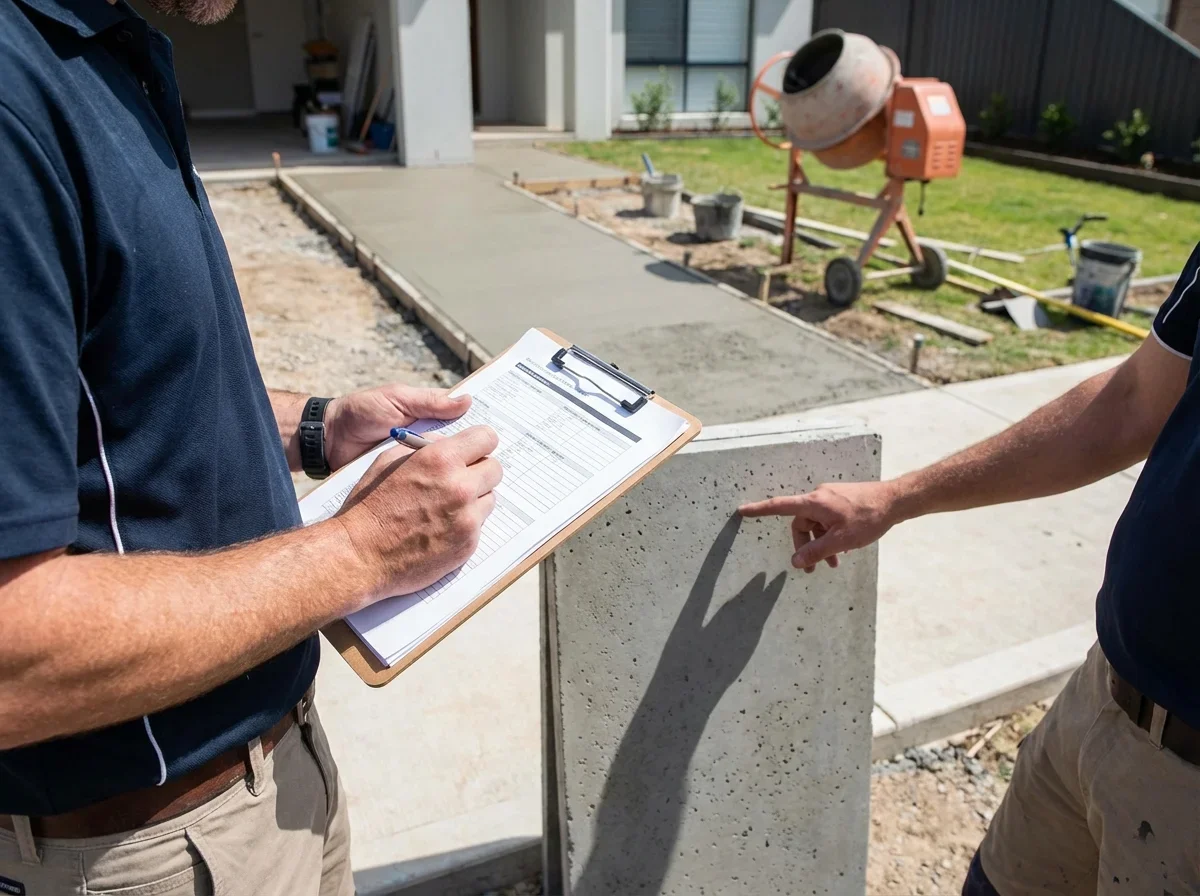
Red Flags That Should Make You Walk Away
Some warning signs are obvious — unlicensed contractors, no insurance, or refusal to provide a written contract. Others are subtler but just as concerning.
Trust your instincts when something feels off, because it usually is.
High-pressure sales tactics signal a contractor who prioritizes landing jobs over doing quality work. "I can only offer this price if you sign today" or "I have materials left over from another job" are classic manipulation techniques. Legitimate contractors don't need to pressure you because their work speaks for itself and they stay busy through referrals.
All-cash deals or requests to pay in cash "to save on taxes" should end the conversation immediately. This isn't about getting a discount — it's about a contractor operating illegally, evading taxes, and leaving you with no paper trail if the work fails.
Without a proper contract and payment record, you'll have no recourse when problems arise.
A contractor who can start immediately despite it being peak season is probably not in demand for a reason. Quality contractors book out weeks or months in advance during busy periods. Someone with wide-open availability either just had a customer cancel (why?), is desperate for work because they're new or struggling, or doesn't have the reputation to keep their schedule full.
Vague or verbal-only contracts create endless disputes. Everything should be in writing: scope of work, materials specifications, timeline, payment schedule, warranty terms, and what happens if either party needs to cancel.
A contractor who resists putting terms in writing is keeping their options open to change prices, cut corners, or walk away if a better job comes along.
Watch for contractors who can't provide local references from the past year. A successful residential contractor should have multiple satisfied customers willing to vouch for their work. If they only offer vague assurances or references from years ago, either they haven't been working or their recent customers weren't happy.
Pro Tip: If a bid comes in 30% or more below competing quotes, don't celebrate the savings — investigate the difference. Ask specifically what they're doing differently: thinner concrete, less reinforcement, minimal site prep, or rushed curing? A legitimate contractor can explain their lower price with specific methodology differences. A corner-cutter will give vague answers or get defensive.
Find Pre-Screened Contractors in Our Directory
You've done your homework and know what to look for. Now comes the time-consuming part: finding contractors who meet these standards, requesting quotes, and comparing proposals.
Most homeowners contact five to seven contractors before finding the right fit, spending hours on phone calls and site visits.
Our directory cuts through this process by connecting you with concrete contractors who've already cleared the credential hurdles. Every listed contractor has verified licensing, current insurance, and a track record of completed residential projects. You can compare multiple qualified contractors in your area, read reviews from homeowners who've hired them, and request quotes without wondering if you're inviting an uninsured, unlicensed operator to your property.
The directory doesn't make your decision for you — you still need to ask the right questions, compare proposals, and choose the contractor who's the best fit for your specific project.
What it does is ensure you're starting from a pool of legitimate professionals rather than sorting through whoever happens to rank highest on a search engine that day. When every contractor you're considering meets baseline standards for licensing and insurance, you can focus on comparing experience, approach, and value rather than weeding out operators who shouldn't be in business at all.
- Wisconsin Department of Safety and Professional Services (DSPS). "Dwelling Contractor." https://dsps.wi.gov/Pages/Professions/DwellingContractor/Default.aspx. Accessed February 09, 2026.
- Wisconsin Builders Association. "Certification." https://www.wisbuild.org/certification. Accessed February 09, 2026.