What Counts as a Small Concrete Job?
In contractor terms, a "small job" typically means anything under 200 square feet or projects requiring a single concrete truck pour. This includes sidewalk sections (4-6 feet wide by 20-30 feet long), small patios under 150 square feet, shed pads, short driveways to detached garages, front steps, and stoops. These projects usually require less than 2-3 cubic yards of concrete—the threshold where delivery minimums and mobilization costs dramatically inflate your per-square-foot price.
The 200-square-foot benchmark matters because it represents the tipping point in contractor economics. Below this size, fixed costs dominate your quote. A crew still needs to travel to your site, unload equipment, prep the area, and coordinate concrete delivery whether they're pouring 50 square feet or 500. Many Fox Valley homeowners express surprise at quotes for "basic jobs" that seem disproportionately expensive, not realizing they're paying for the entire mobilization process, not just materials and labor time.
Why Do Small Concrete Projects Cost More Per Square Foot?
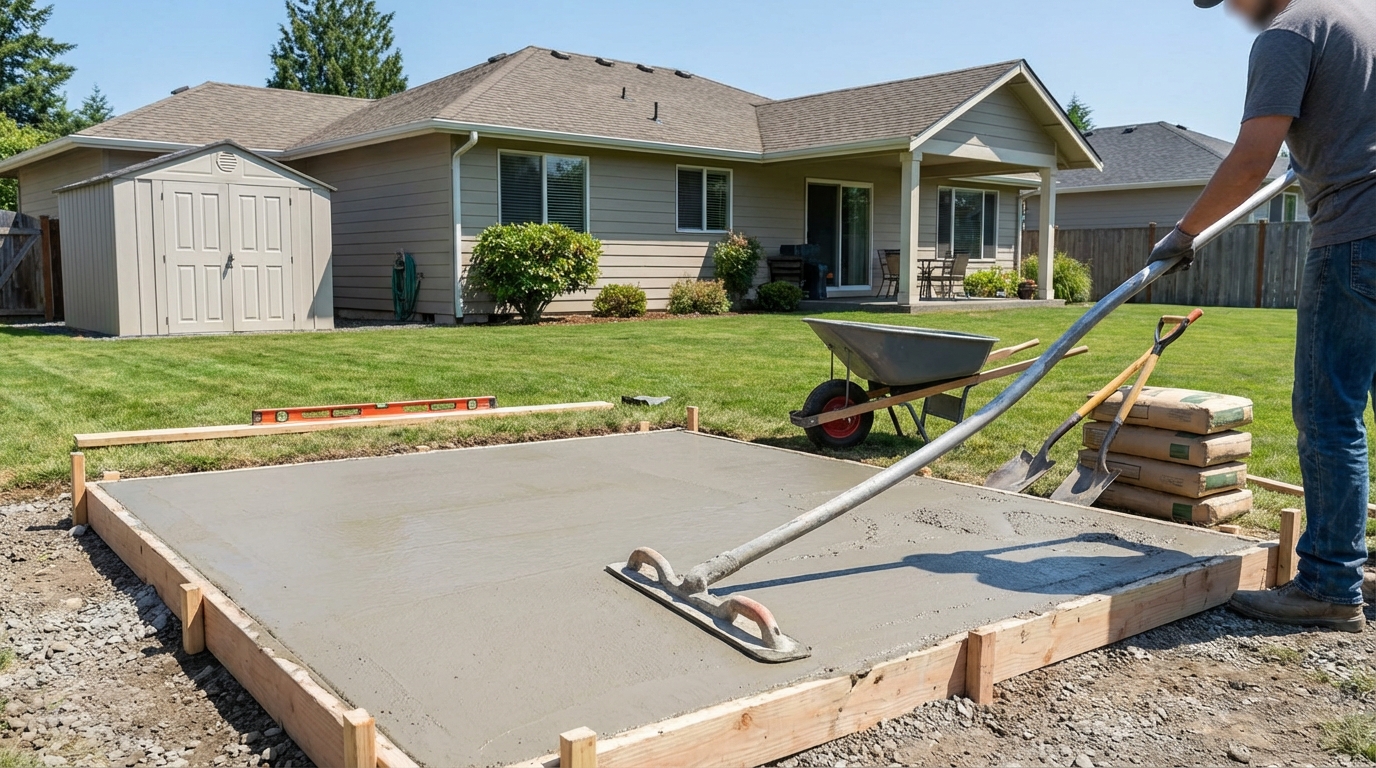
Your small concrete job costs $12-18 per square foot while large commercial pours run $6-10 for a simple reason: you're absorbing fixed costs across far fewer square feet[3]. Think of it like ordering pizza delivery—whether you order one pizza or five, you're paying that $5 delivery fee. In concrete work, that "delivery fee" includes truck minimums, equipment setup, and crew mobilization, but it's hundreds of dollars instead of five bucks.
Contractor Mobilization and Minimum Charges
When a concrete crew arrives at your home, they're bringing a minimum of 2-3 workers, a skid steer or plate compactor, screeds, floats, edging tools, forms, and often a power trowel. Loading, transporting, and unloading this equipment takes 1-2 hours before anyone touches your project. The crew's time starts when they leave the shop, not when they start pouring. For a contractor paying $25-35/hour per crew member plus equipment costs, that's $150-250 in mobilization before the first shovelful of gravel hits your site.
Most contractors establish minimum project charges ($800-1,500 in Fox Valley) to cover these fixed costs. That's why your 30-square-foot stoop repair might cost $1,200—you're not paying $40 per square foot for concrete; you're paying a minimum charge that makes the trip worthwhile for the contractor.
Material Delivery Minimums
Ready-mix concrete plants enforce minimum delivery charges, typically for loads under 4-5 cubic yards. A small 100-square-foot patio at 4 inches thick requires just 1.25 cubic yards—well below the minimum. You'll pay a short-load fee of $50-150, plus the base delivery charge ($80-120 in the Fox Valley), plus the concrete itself ($120-140/yard). That's $350-450 just for material delivery on a project requiring less than $200 worth of actual concrete.
Some contractors maintain relationships with plants that waive short-load fees if they're frequent customers, but smaller operators can't negotiate these deals. This explains why established contractors with steady volume sometimes offer better small-job pricing than newer companies—they've earned delivery concessions.
Equipment and Crew Economics
Proper concrete work requires specialized equipment that doesn't scale down for tiny jobs. A crew still needs the same plate compactor to achieve proper base compaction[2], the same concrete mixer truck delivery, and the same finishing tools whether they're working on 50 square feet or 5,000. Labor efficiency drops dramatically on small jobs too—a crew that can pour and finish 1,000 square feet in a day might only complete your 80-square-foot project in 4-5 hours, but they can't book a second full job that afternoon.
This explains why many contractors prioritize commercial work or large residential projects. A $15,000 driveway pays better per day of work than three $1,200 sidewalk sections, even though the total revenue is similar. Homeowners frequently note difficulty finding contractors willing to take small jobs, especially during busy spring and fall seasons when crews can stay booked on higher-margin work.
Why Small Concrete Jobs Cost More: Quick Breakdown
- Mobilization costs: $150-250 per visit (2-3 crew members + equipment transport)
- Minimum charges: $800-1,500 to make trips economically viable
- Short-load fees: $50-150 added when ordering under 4-5 cubic yards
- Base delivery charge: $80-120 regardless of concrete volume
- Equipment requirements: Same specialized tools needed for 50 sq ft as 5,000 sq ft
- Labor inefficiency: Crews can't book second jobs after small morning pours
Typical Small Job Costs in Fox Valley
Real-world pricing in the Appleton, Green Bay, and Oshkosh areas reflects both material costs and the economic realities we've discussed. These ranges represent quotes from licensed, insured contractors who do proper prep work—not the lowest bids you might encounter.
Sidewalk Sections and Walkways
Expect $12-16 per square foot for sidewalk repairs or extensions. A typical 4-foot-wide by 25-foot-long section (100 square feet) runs $1,200-1,600. This includes excavation to 8-10 inches depth, 4-6 inches of compacted gravel base, 4 inches of 3,000-psi concrete, and proper finishing with control joints every 4-5 feet to control cracking[1].
Shorter sections cost proportionally more. A 40-square-foot front walk patch often hits the $800-1,200 minimum charge range, working out to $20-30 per square foot. Some homeowners report quotes feeling "too much" for what seems like simple work, but remember you're paying for the entire service call, not just the concrete square footage.
Small Patios and Shed Pads
Small patios (100-150 square feet) typically cost $1,400-2,400, or $14-16 per square foot. Shed pads run similar pricing—a 10x12 pad (120 square feet) averages $1,600-2,000. These prices assume standard broom-finish concrete on a properly prepared base. Add $3-5 per square foot for decorative finishes like stamped patterns or integral color, though many contractors set minimum charges for decorative work that make small projects cost-prohibitive.
Fox Valley homeowners have reported getting "beautiful results" on small patios from local contractors who complete the work in one day, though follow-up issues like incomplete cleanup or minor fixes occasionally require callbacks.
Steps and Stoops
Front steps and stoops represent some of the most expensive small jobs per square foot because they require additional forming, often reinforcement with rebar, and careful attention to rise-run calculations for safe treads. A typical 3-step entry (roughly 20-30 square feet of concrete) costs $1,000-1,800. Single-step stoops still hit minimum charges of $800-1,200.
Steps also carry higher liability for contractors—poorly designed or executed stairs create trip hazards and potential lawsuits. This risk premium factors into pricing, especially for contractors working in residential neighborhoods where reputational damage from a problematic project spreads quickly through community networks.
| Project Type | Size | Total Cost | Per Sq Ft Cost | Timeline |
|---|---|---|---|---|
| Sidewalk Section | 100 sq ft (4'×25') | $1,200-$1,600 | $12-$16 | 1 day |
| Small Patio | 120 sq ft (10'×12') | $1,680-$1,920 | $14-$16 | 1 day |
| Shed Pad | 120 sq ft (10'×12') | $1,600-$2,000 | $13-$17 | 1 day |
| Front Steps (3-step) | 25 sq ft | $1,000-$1,800 | $40-$72 | 1 day |
Should You DIY Small Concrete Projects?
The cost differential between professional work and DIY bags of concrete makes homeowners consider handling small pours themselves. Reality check: most DIY concrete fails within 2-5 years, requiring professional replacement that costs more than doing it right initially. Bagged concrete costs $6-8 per 80-lb bag, and you need roughly 14-15 bags per cubic yard. That 100-square-foot patio requiring 1.25 yards means buying 18-20 bags ($110-140) plus tools, forms, gravel, and your labor.
You'll save maybe $900-1,200 on a project where improper execution creates expensive problems. Residential concrete slabs require minimum 4-inch thickness, proper subbase compaction, vapor barriers beneath to prevent moisture infiltration, and correct concrete mix (3,000 psi minimum) to avoid issues like curling or settlement[2]. Without experience, you'll likely pour too thin (causing cracking), skip the vapor barrier (causing moisture issues), inadequately compact the base (causing settling), or finish incorrectly (causing scaling).
The exception: very small, non-structural projects like decorative stepping stones or garden borders where failure isn't catastrophic. For anything load-bearing—walkways, patios, steps, shed pads—professional work pays for itself through longevity.
Find Fox Valley Contractors Who Welcome Small Residential Jobs — Connect with concrete pros who specialize in residential small work and won't treat your project as an inconvenience.
How to Reduce Costs on Small Residential Work
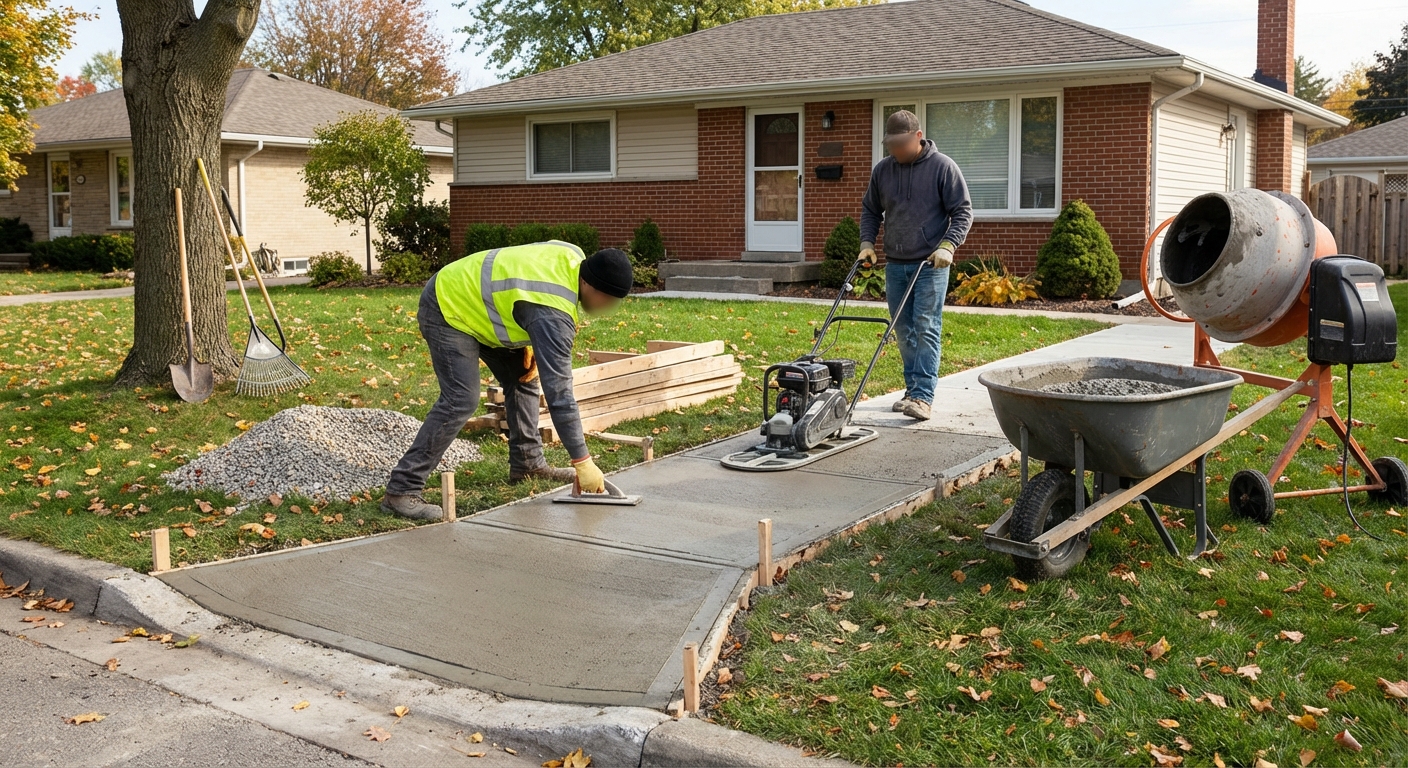
Strategic approaches can lower your effective per-square-foot cost without sacrificing quality. The most effective: bundle multiple small projects into a single mobilization. If you need both a sidewalk section and a shed pad, having them poured during the same visit eliminates one mobilization charge. Your total cost might be $2,400 instead of $1,200 + $1,400 = $2,600 for separate jobs.
Neighbor coordination works even better. If three households on your block need small concrete work, approach contractors about a multi-home project. The crew can stay on your street for 2-3 days, eliminating repeated mobilization costs. Each homeowner saves 15-25% compared to individual projects. This requires coordination effort, but Fox Valley homeowners who've organized neighborhood projects report savings of $300-500 per household.
Timing matters too. Book during shoulder seasons (late fall or early spring) when contractors have lighter schedules and may reduce minimum charges to keep crews working. Mid-summer peak season? You'll pay top dollar and wait weeks for scheduling. A May or October booking often yields 10-15% lower quotes from contractors eager to fill gaps between larger jobs.
Consider alternative repairs before committing to replacement. For sunken or settled concrete, mudjacking or polyurethane foam leveling costs $3-7 per square foot—far less than $12-16 for replacement. Homeowners report "cheap fixes" for trip hazards with 5-year warranties, saving substantial money versus full pours. If your concrete is structurally sound but uneven, leveling makes economic sense.
Finding Contractors Who Do Small Jobs
Not all concrete contractors welcome residential small work—many focus exclusively on commercial projects or large residential jobs. Finding small-job specialists requires targeted searching. Look for contractors who explicitly advertise "residential repairs," "sidewalk sections," or "small concrete projects" rather than just "concrete contractors." Their websites often show galleries of small patios, walkways, and steps rather than parking lots and commercial foundations.
Local, family-owned operations typically handle small jobs more readily than large crews with commercial contracts. Fox Valley homeowners specifically mention success with Appleton-area contractors who maintain city contracts for residential sidewalk work—they're equipped to handle small projects efficiently because they do them routinely. When requesting quotes, ask directly: "What percentage of your work is residential projects under 200 square feet?" If the answer is less than 30%, you may face reluctance or premium pricing.
Responsiveness during the quoting phase predicts overall service quality. Contractors who return calls within 24 hours, schedule estimates promptly, and provide detailed written quotes typically deliver better customer experiences than those who treat small jobs as low-priority. Homeowners note that communication quality from initial contact through project completion correlates strongly with satisfactory outcomes.
Compare Small Job Quotes from Multiple Pros — Get detailed estimates breaking down mobilization, materials, and labor from at least three contractors who regularly handle residential small work.
Why 'Cheap' Concrete Isn't a Bargain
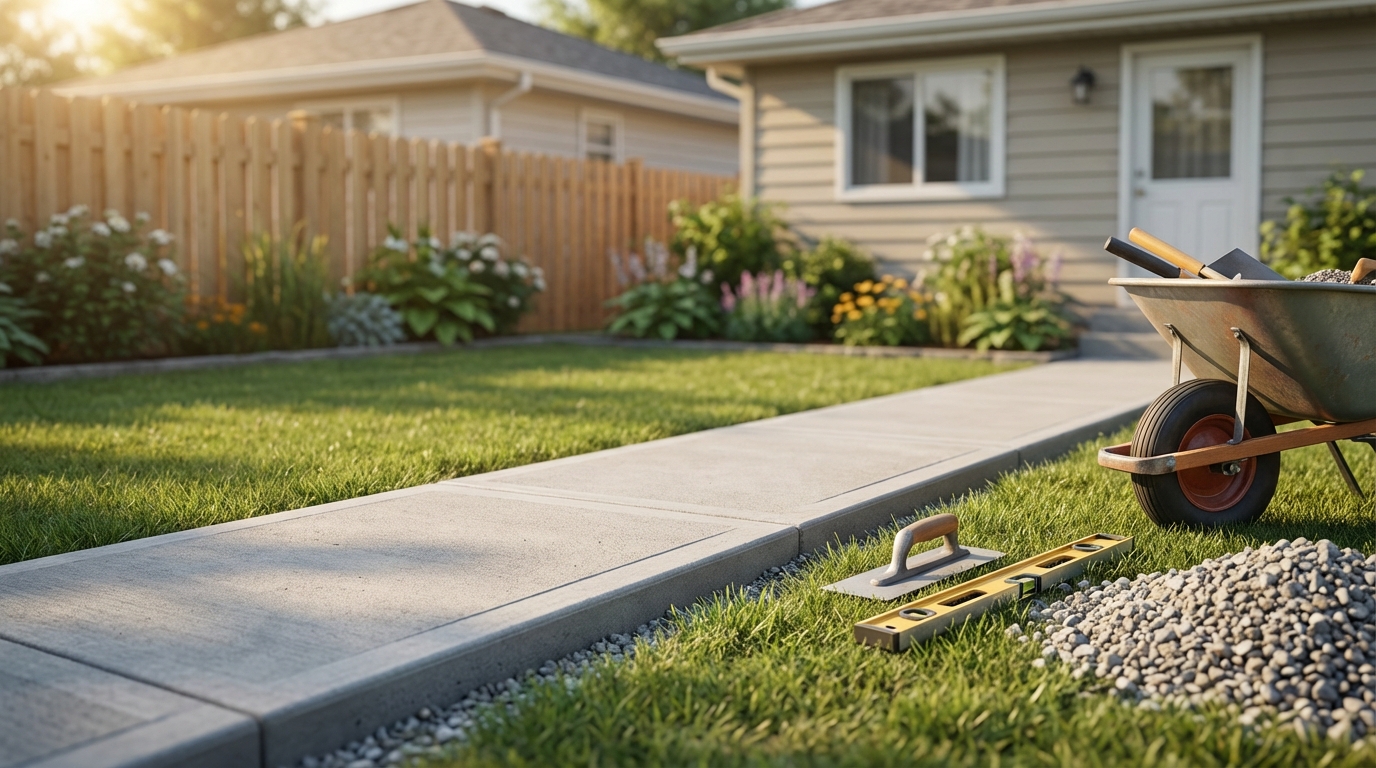
That quote for $800 when everyone else bid $1,400 isn't a bargain—it's a warning sign. Concrete work has non-negotiable material and labor costs for proper execution. Drastically low bids mean the contractor is cutting corners, lacks proper insurance, or plans to upsell aggressively once work begins. The most common corners: thin pours (3 inches instead of 4), eliminated vapor barriers, inadequate base preparation, and weak concrete mixes below 3,000 psi[2].
Thin concrete cracks within months. Skipped vapor barriers cause moisture problems and deterioration. Poor base prep leads to settling and uneven surfaces. Weak concrete mixes scale and spall during freeze-thaw cycles—especially problematic in Wisconsin winters. These failures require complete replacement within 2-5 years, costing more than proper initial installation.
Homeowners who prioritized "lowest price" over verified quality consistently report follow-up issues requiring expensive repairs. The pattern is predictable: suspiciously cheap quote, quick work that looks acceptable initially, then problems emerge within a year. Meanwhile, those who selected mid-range quotes from licensed, insured contractors with documented portfolios report work lasting 15-20 years without issues.
Verify licensing and insurance in writing before signing contracts. Wisconsin requires contractors to carry general liability insurance and workers' compensation if they have employees. Ask for certificates of insurance—reputable contractors provide them immediately. Also request references for similar small projects completed in the past two years, and actually call them. This 30-minute verification process protects you from disasters that cost thousands to remediate.
Pro Tip: When a concrete quote seems too good to be true, ask the contractor to detail their base preparation process and concrete specifications in writing. Legitimate professionals will gladly specify 4-inch thickness, 3,000-psi concrete, vapor barriers, and compacted gravel base. Contractors planning to cut corners usually become evasive when asked for written specifications—that evasiveness is your red flag to walk away.
Get Quotes from Small Job Concrete Contractors
Small residential concrete work costs more per square foot than large projects due to unavoidable mobilization charges, material delivery minimums, and equipment economics. In Fox Valley, expect $12-18 per square foot for professional work on projects under 200 square feet, with many contractors enforcing minimum charges of $800-1,500. This pricing isn't gouging—it's basic business economics that reflect real costs contractors incur.
Your best strategy combines realistic expectations, strategic bundling to reduce per-job costs, and careful contractor selection focused on small-job specialists. Avoid both the DIY temptation (which usually fails expensively) and the lowest-bid trap (which fails even faster). Instead, target the mid-range quote from contractors who demonstrate specific experience with residential small work, carry proper insurance, and communicate professionally from first contact.
Ask a Contractor: Is Your Project Worth Doing Professionally? — Not sure if your small concrete job justifies professional work or if DIY makes sense? Get expert opinions from contractors who'll give honest assessments.
The reality is that quality small concrete work costs real money, but it lasts 15-20+ years when done correctly. That $1,500 sidewalk section breaks down to $75-100 per year over its lifespan—reasonable for infrastructure that handles daily foot traffic through Wisconsin winters. Focus on finding contractors who welcome your small project rather than those who treat it as an inconvenience, verify their credentials thoroughly, and expect to pay fair rates that reflect actual costs. Your concrete will last longer, look better, and cause fewer headaches than bargain-basement alternatives that crumble within years.
- Federal Highway Administration (FHWA), U.S. Department of Transportation. "Concrete Parking Lots and Driveways." https://www.fhwa.dot.gov/publications/research/infrastructure/pavements/ltp/02079/chapt_06.cfm. Accessed February 07, 2026.
- National Ready Mixed Concrete Association (NRMCA). "Concrete Slabs on Grade: Residential Construction Information Sheet." https://www.nrmca.org/wp-content/uploads/2018/02/ResidentialConcreteSlabInfoSheet.pdf. Accessed February 07, 2026.
- University of Minnesota Extension. "Concrete Construction Best Practices for Residential Projects." https://extension.umn.edu/concrete/concrete-home-projects. Accessed February 07, 2026.